
Some things are best kept out of your neighbors’ view. What you wear, or don’t wear, during a late-night hot tub soak ranks pretty high on that list.
That’s why hot tub privacy matters. It isn’t only about blocking views. It’s about making your spa area a place where you can switch off, relax, and enjoy the moment without feeling watched from nearby yards or upstairs windows.
The thing is, hot tub privacy sits in the middle ground between architecture, landscaping, and interior design. Get it wrong, and you’ve either spent thousands on something that doesn’t do the job or ended up with an eyesore that makes your backyard look like a prison yard.
Some people want total seclusion, while others just want enough screening to feel comfortable.
The options in this article range from very simple to well-designed, and honestly, the best approach usually comes from looking past the usual fence and hedge combo everyone falls back on.
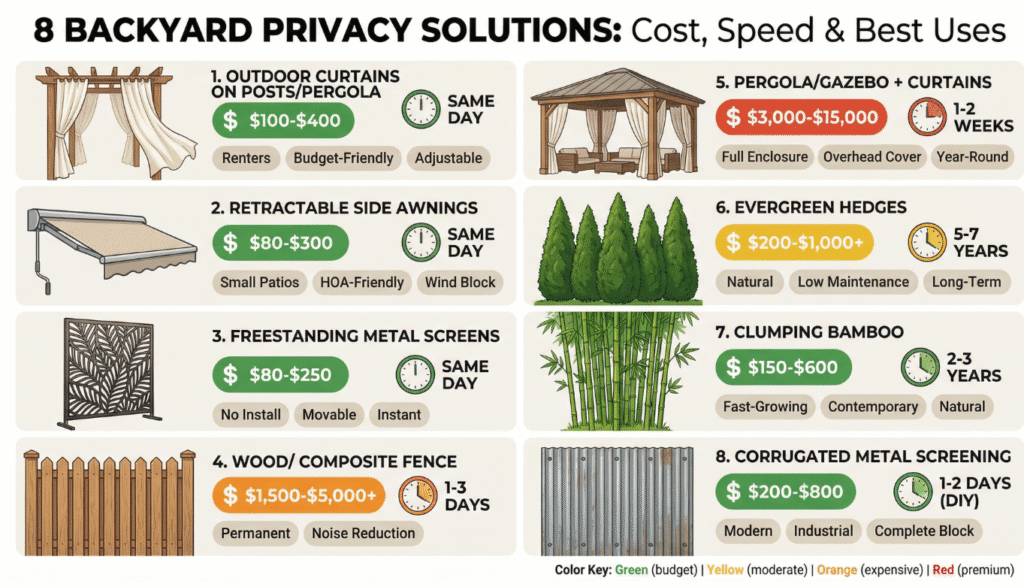
Here’s a quick breakdown of what works, what it costs, and how fast you’ll get results:
Disclosure: As an Amazon Associate I earn from qualifying purchases at no extra cost to you.
Before You Start Adding Privacy to Your Backyard
Before you start building walls or planting hedges, you need to understand what you’re actually trying to accomplish.
The person with a ground-level hot tub facing a busy street has completely different needs than someone with an elevated deck spa overlooking their own wooded backyard.
Acoustic privacy matters too, and people usually don’t think much about it until they realize the neighbors can hear every conversation and every splash.
Then there’s psychological privacy, that feeling of seclusion even when you’re not technically hidden from every possible angle.
A semi-transparent screen might not block every line of sight, but it can create enough separation that you feel comfortable, which is really what matters.
Ensure you walk around your property at different times of day, look at your hot tub location from every possible angle including upper floors, and identify exactly where the privacy gaps exist. Take photos from different vantage points.
Ask yourself where someone would be standing or sitting if they were looking at your hot tub. This exercise reveals blind spots you wouldn’t notice otherwise.
Seasonal changes matter too, especially if you’re considering living barriers. That beautiful hedge providing perfect summer coverage might turn into a skeletal framework come November, exposing your winter spa sessions to the entire neighborhood.
Year-round solutions cost more upfront but save you from that awkward realization in December when the leaves are gone and you suddenly understand why your neighbor has been avoiding eye contact.
Permanent Backyard Hot Tub Privacy Ideas That Work
Wood Fencing for Hot Tub Privacy
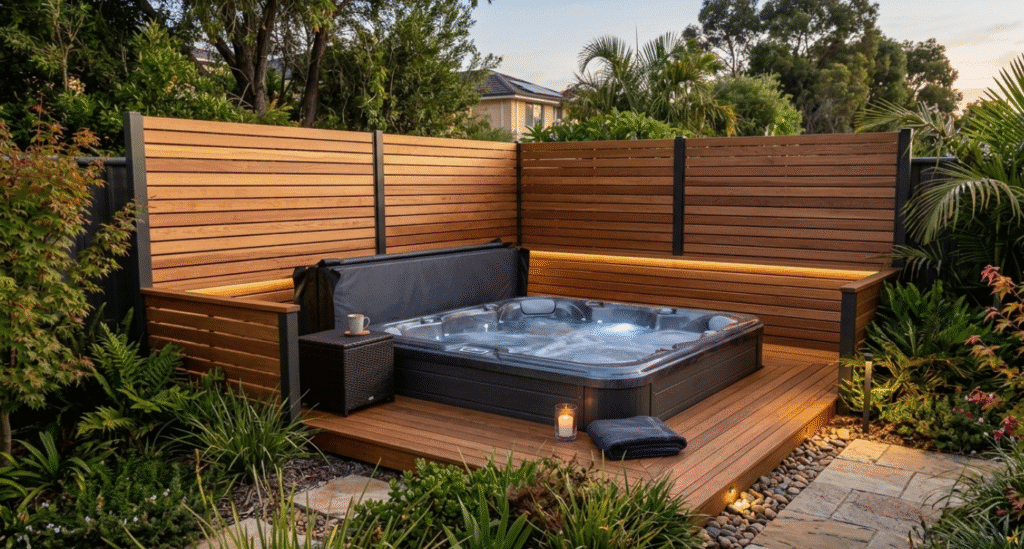
Wood fencing gives you that natural warmth and can be customized to virtually any height or style. The reality is that wood needs annual maintenance, usually staining or sealing, to prevent rot and weathering.
Skip that maintenance and you’re looking at replacement in 8-10 years instead of 20-25.
Cedar and redwood naturally resist decay better than pressure-treated pine, but they cost roughly 30-50% more per linear foot.
Composite Fencing for Hot Tub Privacy
Composite fencing solves the two biggest complaints about wood: constant maintenance and eventual rot. The panels interlock with zero gaps between pickets, which means no slivers of visibility as boards shrink or warp over time.
The two brands worth knowing are Trex Seclusions and SimTek.
Trex Seclusions panels look like premium board-on-board wood, made from recycled wood fibers and plastic. They come in 6-foot and 8-foot heights (configurable up to 12 feet where code allows) in 4 colors: Charcoal, Woodland Brown, Winchester Grey, and Saddle. Both sides of the fence look identical, so your neighbor sees the same finished face you do. Trex carries a 25-year warranty against cracking, warping, and rot.
SimTek Ashland panels are molded from recycled polyethylene reinforced with galvanized steel, available in 5 wood-tone colors. Their EcoStone line mimics actual stone for a more architectural feel. SimTek is marketed as being able to withstand hurricane force winds, and is available at Home Depot.
PVC and Vinyl Fencing for Hot Tub Privacy and Noise Reduction
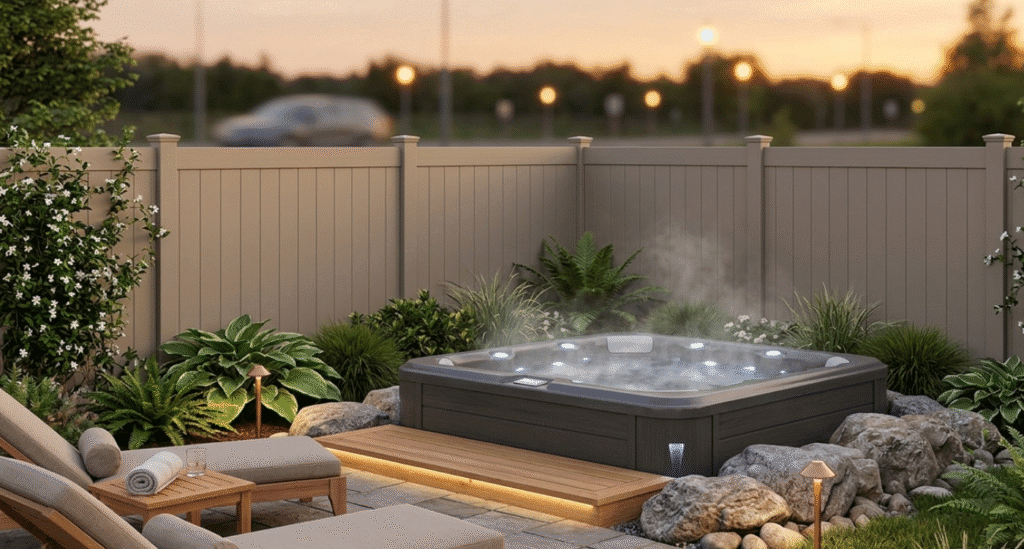
PVC and vinyl fencing needs nothing beyond occasional hosing, however, some options look unmistakably plastic, which can clash with natural landscape designs.
Higher-end vinyl that does a more convincing job of copying wood grain can cost almost as much as composite, so the savings are not that large by that point.
One thing people often miss with solid fencing is noise reduction. A well-built fence can cut incoming street noise by 20 to 50%, which can change the whole hot tub experience if you’re close to traffic or commercial areas.
How much sound gets blocked comes down to the material’s thickness and density. A solid 6 inch wood fence will block a lot more noise than a thin vinyl panel stretched between posts.
Gazebos and Pergolas
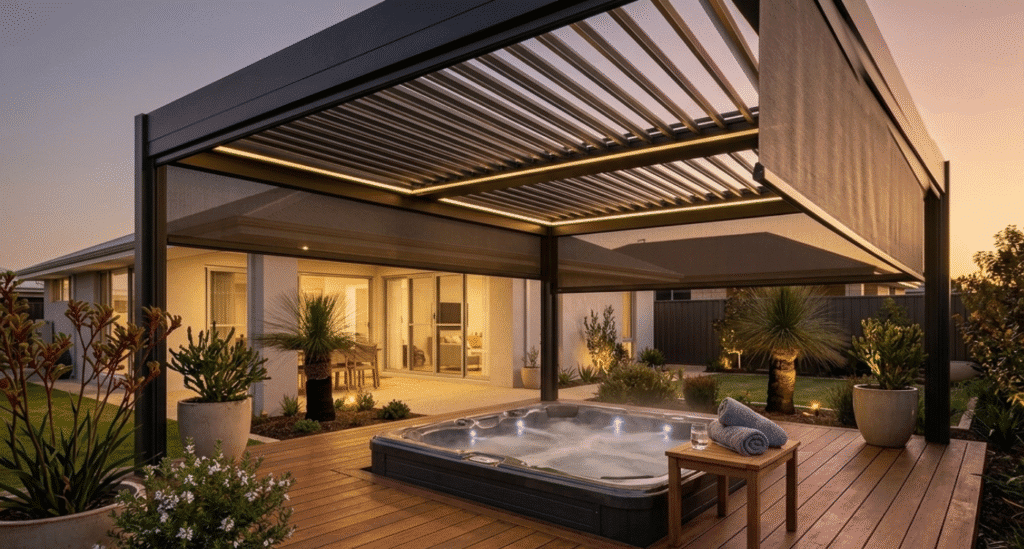
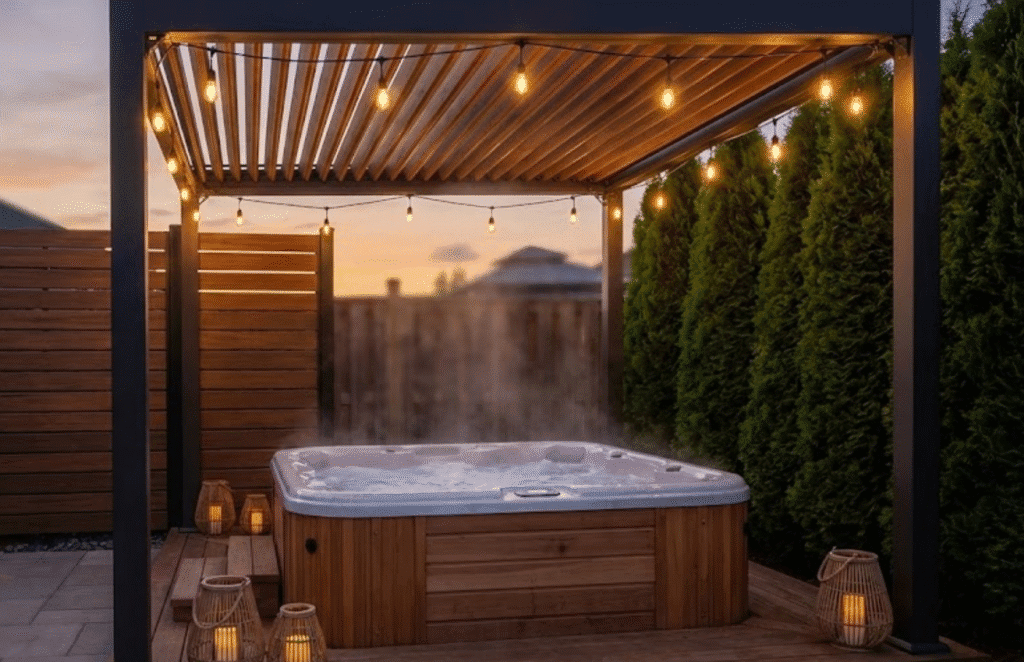
Gazebos and pergolas provide both privacy screening and overhead coverage, making them the only permanent option that blocks views from second-story windows and elevated decks.
A pergola with adjustable slats gives you control over coverage. The overhead structure also reduces temperatures underneath by 5-15 degrees in summer and protects your water from debris, which cuts down on filter maintenance and chemical adjustments.
Gazebos create more complete enclosure with walls and a roof. Built-in insect screening can solve the mosquito problem that plagues evening soaks in humid climates.
The trade-off is cost and commitment. Expect $3,000-$10,000+ depending on size and features, plus potential permit requirements.
Top Gazebo Picks
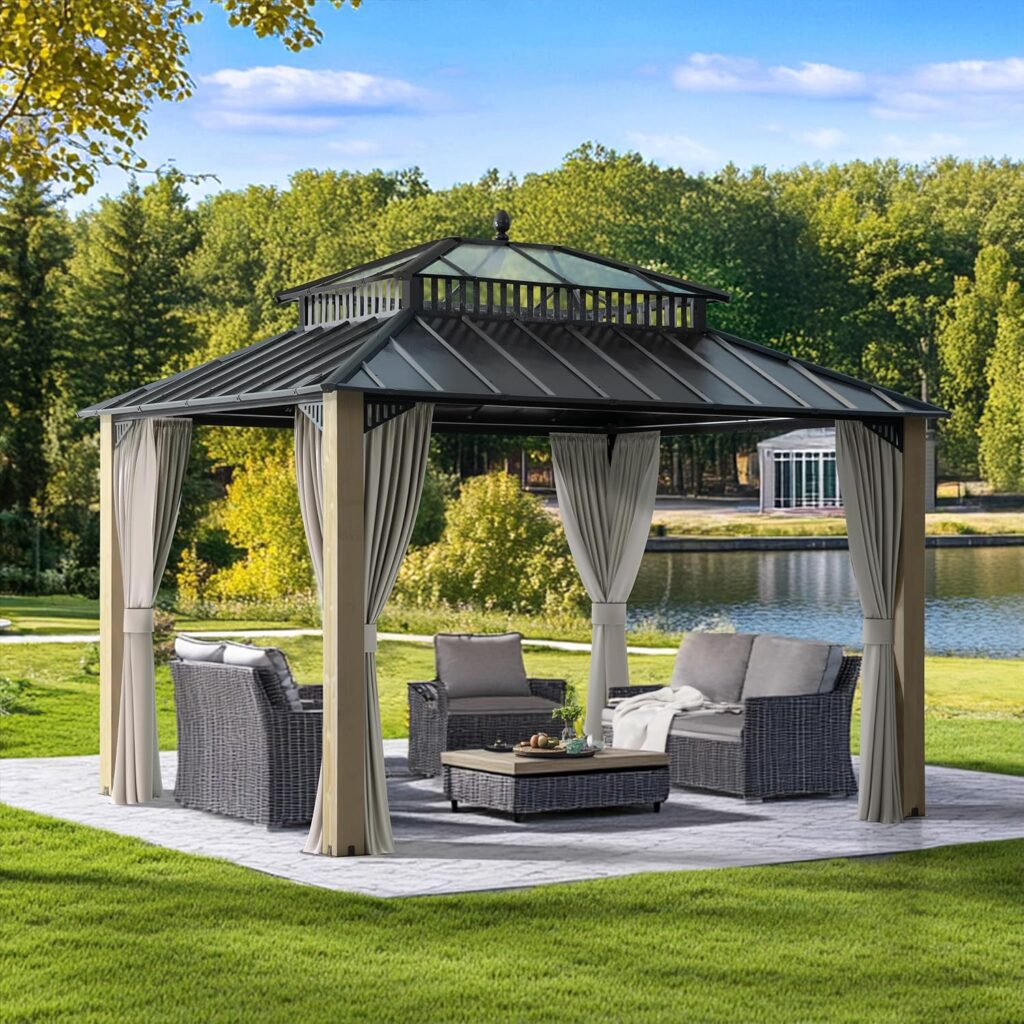
The Sunjoy 12′ x 10′ Hardtop Gazebo is a strong mid-range option.
The rust-resistant steel frame and polycarbonate roof handle weather well, and the included curtains close off all four sides when you want seclusion.
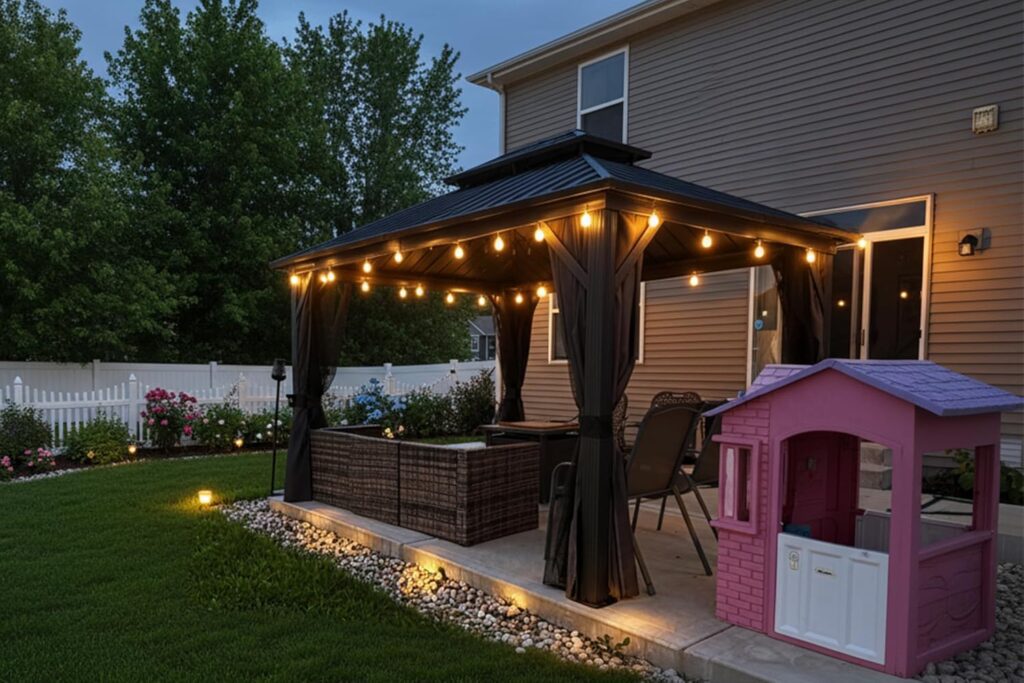
For a more premium option, the PURPLE LEAF 10′ x 12′ Hardtop Gazebo features a galvanized steel double roof on a powder-coated aluminum frame, with curtains and mosquito netting included.
The double-roof design promotes airflow while providing solid UV protection, and built-in string lights add ambiance for evening soaks. At around 10′ x 12′, there’s plenty of room for most hot tubs with space to spare.
Natural Hot Tub Privacy: Evergreens, Bamboo, and Planters
Natural screening through plants and hedges creates privacy that improves over time as opposed to degradation. The challenge is that patience period between installation and maturity.
Evergreen Hedges for Hot Tub Privacy
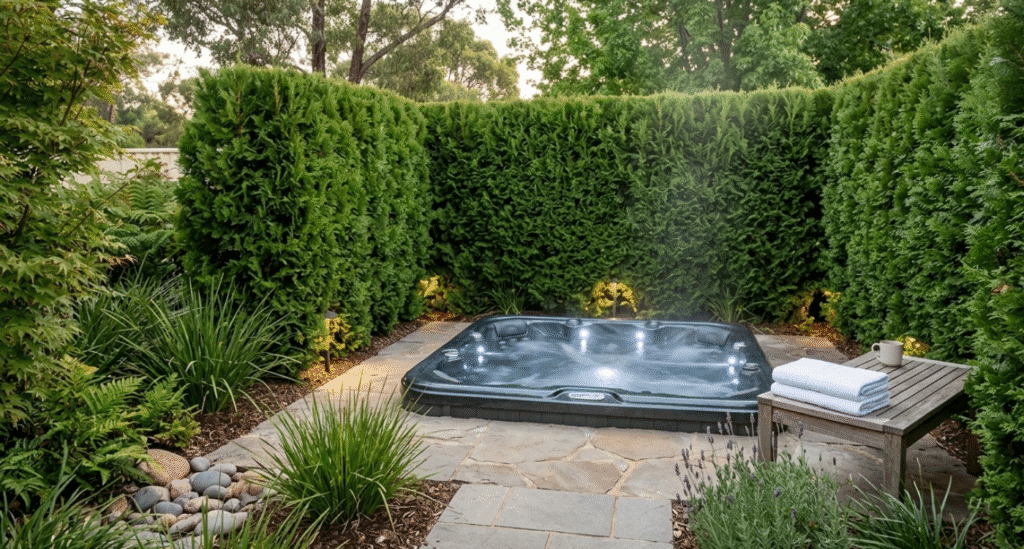
Arborvitae hedges, particularly the Emerald Green variety, grow about 12-15 inches annually under optimal conditions.
Plant them at 3-4 feet tall and you’re looking at 5-7 years before they hit full screening height of 8-10 feet. Once established, they maintain dense year-round coverage and can last 50+ years with annual trimming.
The non-negotiable requirement is sunlight. Arborvitae needs at least six hours of direct sun daily. Plant them in shade and they’ll grow sparse and leggy, which defeats the purpose entirely.
If you need privacy now and want hedges for the long term, pair new plantings with a temporary solution (outdoor curtains or a freestanding panel) while the plants fill in.
Bamboo for Hot Tub Privacy
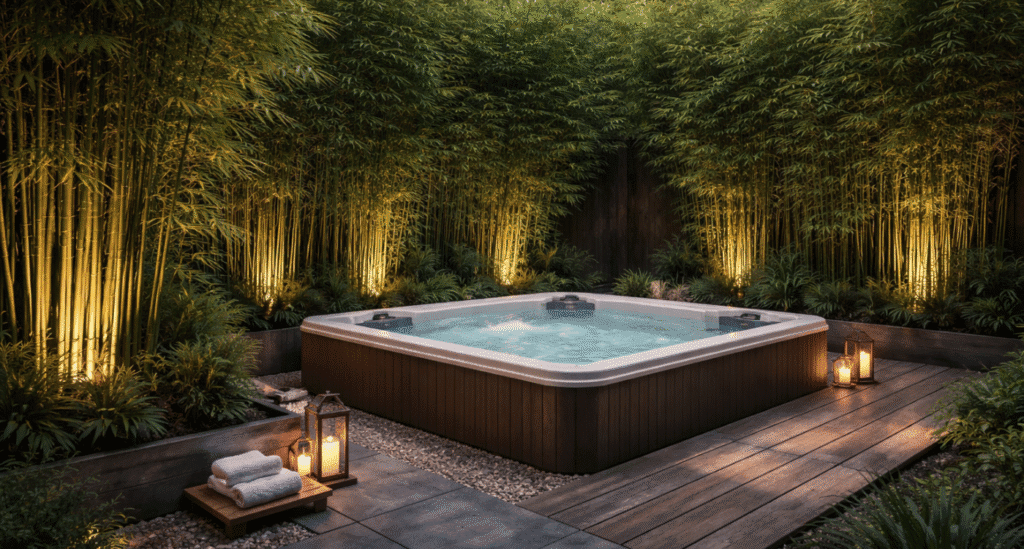
Some bamboo species grow 3-4 feet per season, providing screening in 2-3 years. The look works well for contemporary designs, and bamboo handles the humidity around hot tubs better than many plants.
However, running bamboo varieties spread aggressively through underground rhizomes. Within 5-7 years, you may find shoots emerging 20-30 feet from the original planting. Either install rhizome barriers at planting time ($200-$500) or choose clumping bamboo varieties, which stay contained but grow slower at 12-18 inches per year.
Potted Plants for Hot Tub Privacy
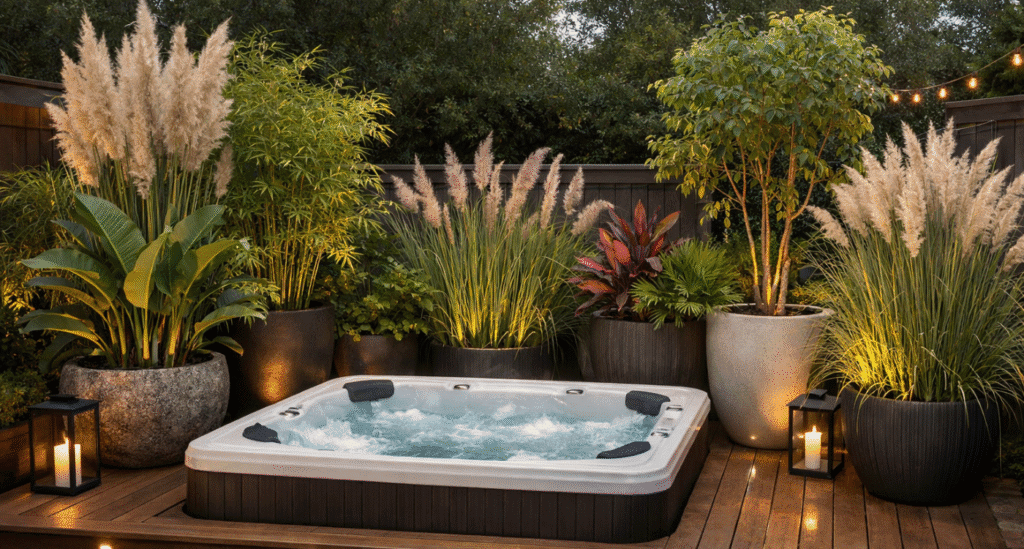
Large containers with tall ornamental grasses or small trees create movable privacy screening. This can work well for renters or anyone who likes rearranging their outdoor space seasonally.
The downside is higher maintenance. Container plants need frequent watering (sometimes daily in summer), regular fertilizing, and overwintering indoors in cold climates.
Flexible and Temporary Backyard Hot Tub Privacy Ideas
This is where most people should start, especially with HOA restrictions, a tight budget, or a rental. Temporary solutions let you test what actually works for your specific sightlines before committing to something permanent.
Outdoor Curtains for Hot Tub Privacy
Outdoor curtains are one of the smartest entry points into hot tub privacy because they’re reversible and adjustable. Heavy-duty, weather-resistant curtain panels hung on rod or cable systems give you complete control.
Close them during use for privacy, open them afterward to maintain views and airflow.
The installation involves mounting posts or attaching to existing structures, then installing the hanging system. Material costs run $40-$400 for most residential hot tub installations, making this more affordable compared to permanent structures.
Choose marine-grade or outdoor-rated fabrics. Repurposed indoor curtains will mildew and fall apart quickly in outdoor conditions.
Top Curtin Picks
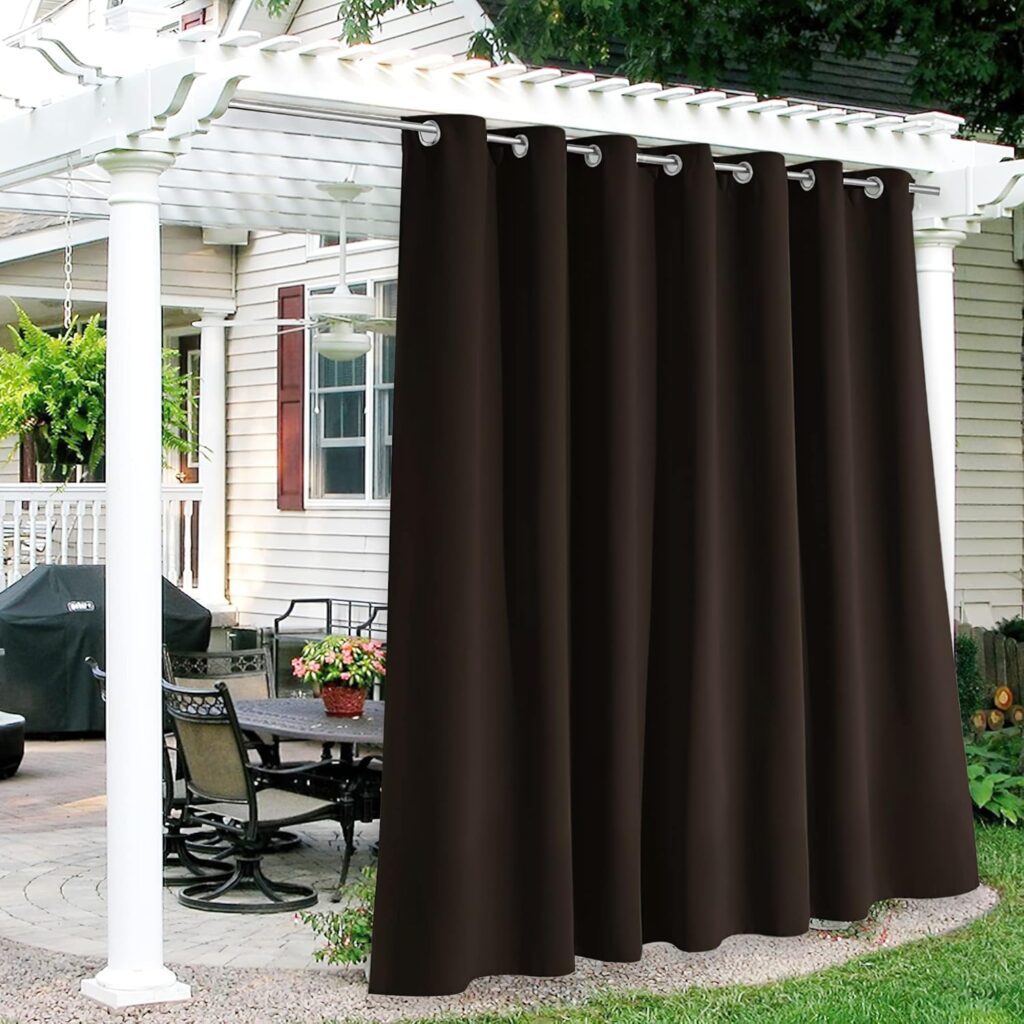
RYB HOME Outdoor Blackout Curtains is a go-to for hot tub privacy.
The triple-weave polyester blocks 85-95% of sunlight and provides real visual privacy rather than the sheer, see-through fabric you get with cheaper options.
They’re waterproof, dry quickly, and come with stainless steel grommets in multiple colors.
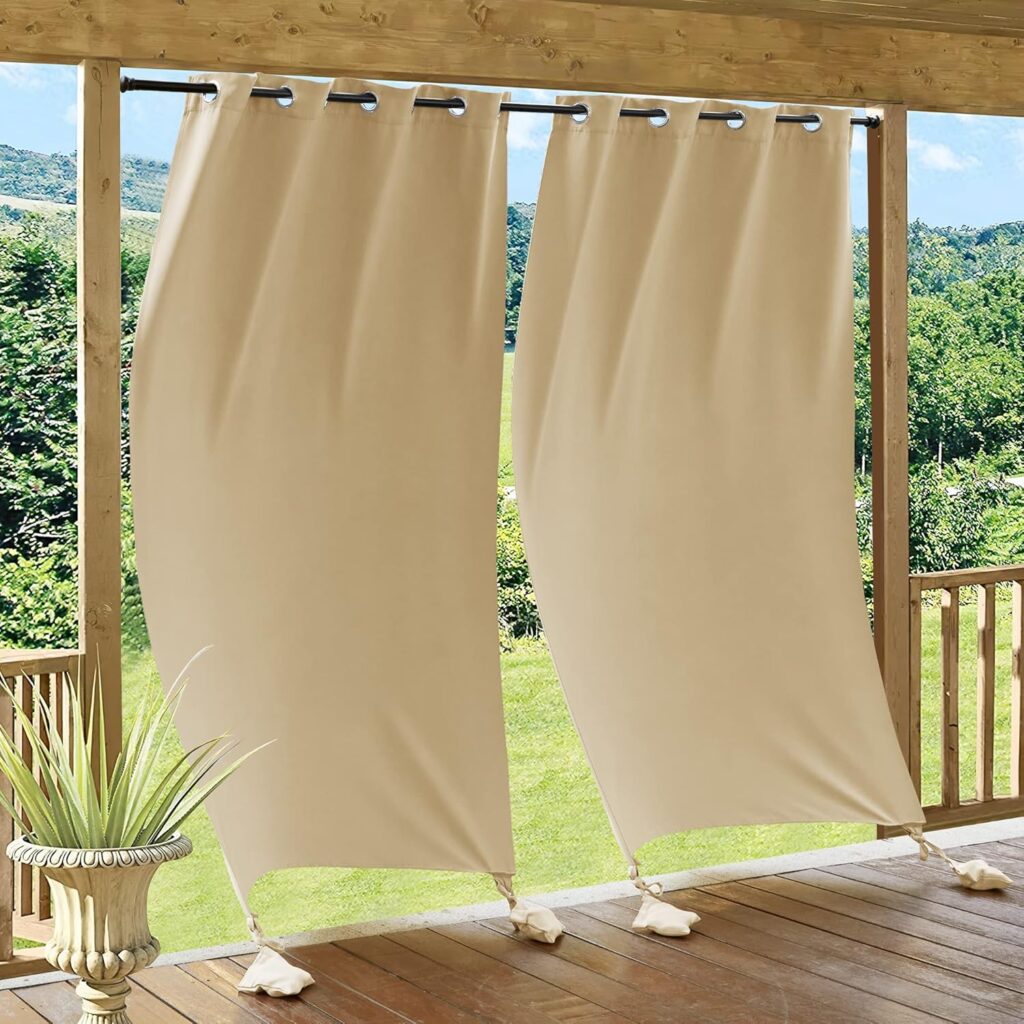
For windy locations, the RYB HOME Windproof version with Weighted Bags keeps panels from flapping.
Worth the small upcharge if gusty conditions are an issue where you live.
Retractable Side Awnings
Retractable awnings mount to a wall, fence, or post and pull out when you need privacy. When you’re done, they retract into a slim housing and virtually disappear.
This makes them a great fit for small patios, narrow side yards, and HOA communities where visible permanent structures may not be allowed.
Top Retractable Side Awnings Picks
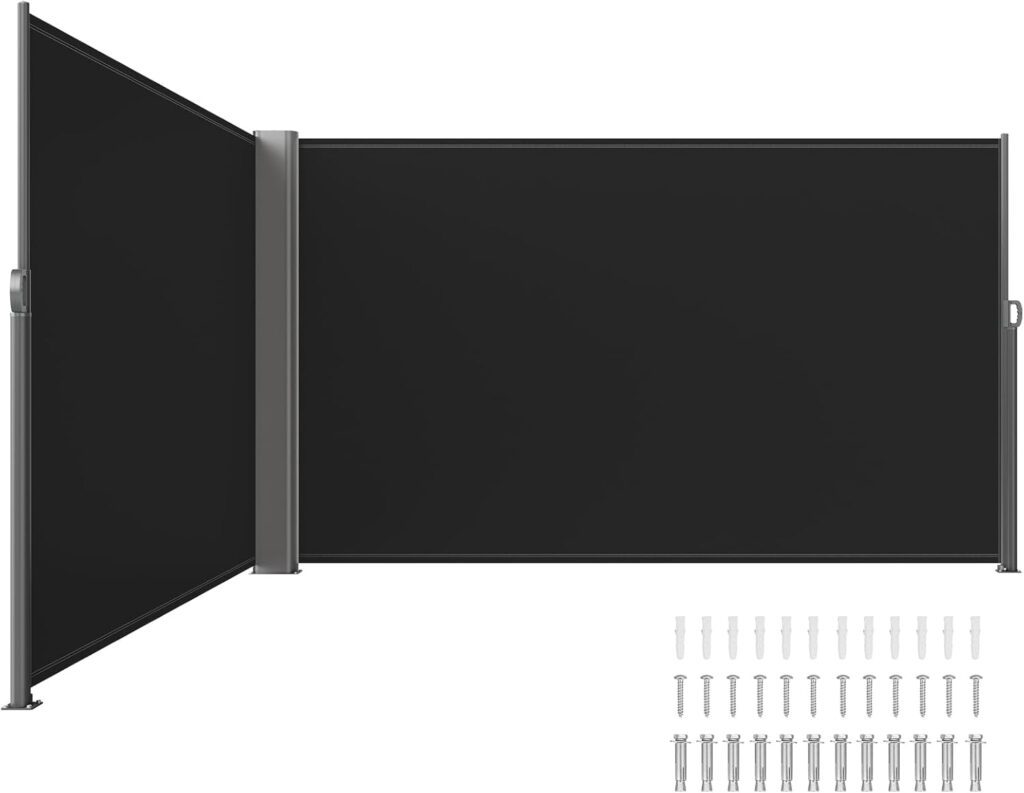
The VEVOR Retractable Side Awning (71″ x 118″) is one of the best quality-to-price points.
It has a full aluminum frame instead of the steel used on cheaper models that can rust, plus 280g/m² fabric with a PU coating and UV 50 protection.
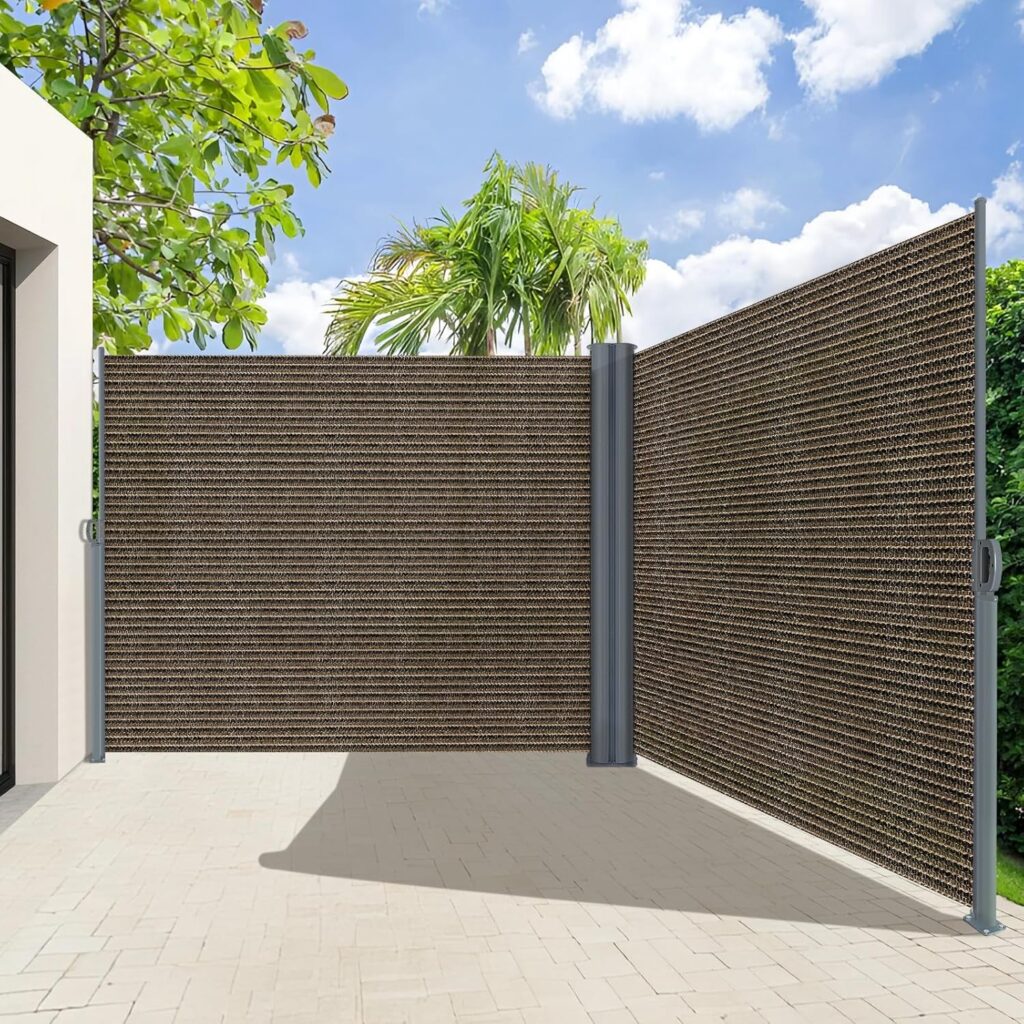
For longer coverage, the KANAGAWA Retractable Side Awning comes in sizes up to 71″ x 236″ (nearly 20 feet), which can screen two full sides of most hot tub areas.
Freestanding Metal Privacy Screens
Freestanding privacy screens dont need any installation. Simply unbox, unfold, and place it where you need screening. These work well as targeted blockers for one specific sightline, like a neighbor’s window or a stretch of low fence.
Top Freestanding Metal Privacy Screen Pick
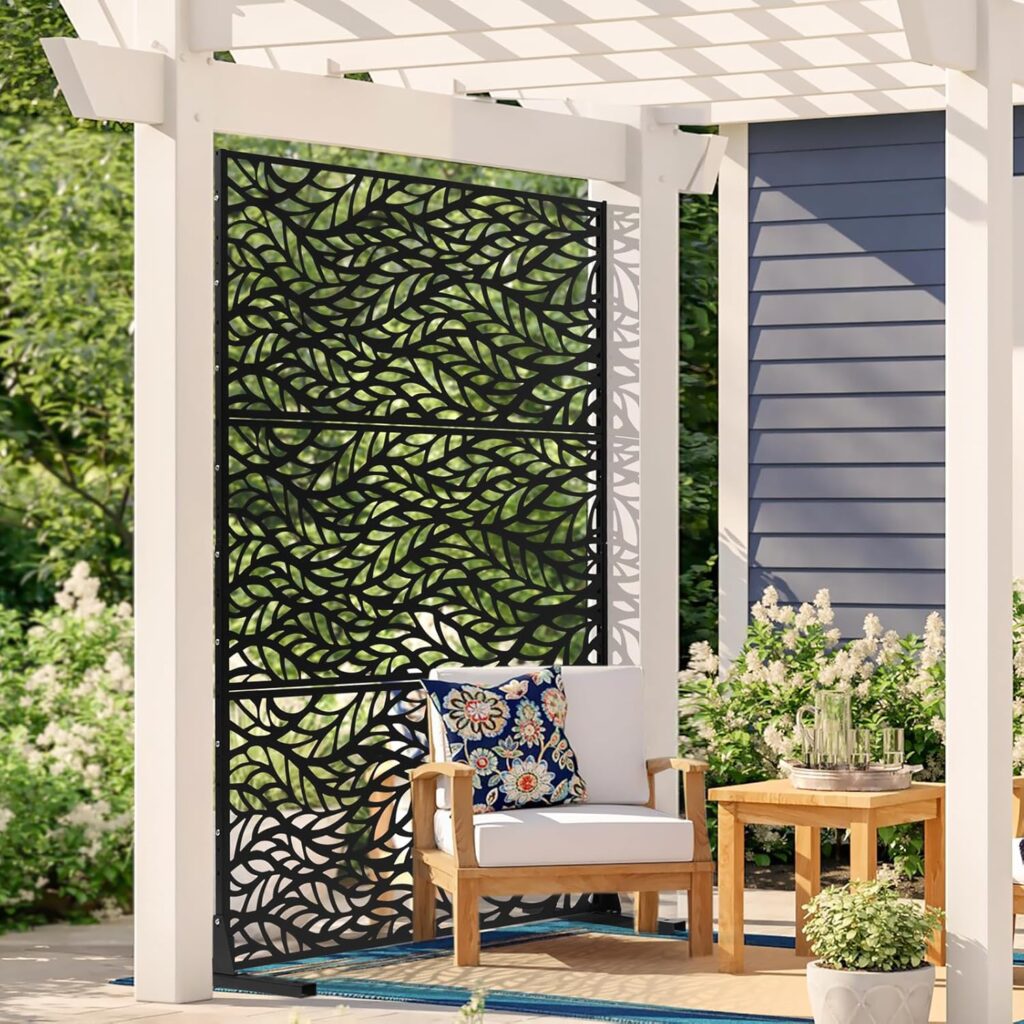
The VEVOR Metal Privacy Screen (47″ W x 76″ H, 3-panel) is heavy enough at about 34 lbs to stay put in moderate wind, unlike lightweight fabric screens that blow over constantly. The three-panel folding design lets you angle it to block specific sightlines, while the decorative pattern adds to backyard decor.
Corrugated Metal Screening for Hot Tub Privacy
Corrugated metal gives you full visual screening with very little upkeep. Strong color choices like cherry red or copper can look especially good with modern architecture.
It works best with mid century modern, contemporary, or industrial style homes. On a colonial or craftsman house, corrugated metal can look out of place.
Hot Tub Privacy Ideas for Small Yards and Narrow Side Yards
Standard advice about gazebos and wide hedges doesn’t apply when your side yard is six feet wide. You need vertical, slim-profile solutions that block sightlines without eating up your limited space.
- Retractable side awnings take up virtually zero floor space when retracted. Mount one to the house wall, extend it to the fence, and you’ve got an instant privacy corridor.
- Tall narrow planters with ornamental grasses or bamboo create living walls with a 12-18 inch footprint. Line three or four along the most exposed fence line for effective screening without losing walkway access.
- Freestanding privacy screens positioned at the most exposed angles can solve the problem without crowding the area.
One thing to keep in mind is not to screen off all four sides. Leave the equipment panel side accessible for service, or use a retractable screen on that side so you can pull it aside when a technician needs access.
Hot Tub Privacy Ideas for Cold Climates
If you’re dealing with serious winters, privacy solutions need to double as windbreaks. A hot tub in 20-degree air feels fine when wind is blocked. Add a 15 mph wind and it becomes miserable.
- Solid fencing on the windward side (usually northwest in northern US states) should be your first priority. The wind block alone can make winter soaking dramatically more comfortable.
- Under-deck installations are underrated. Positioning the tub beneath a raised deck gives you overhead snow protection and built-in privacy on at least two sides. Work with a contractor to ensure proper drainage, ventilation, and structural support.
- Heavy-duty outdoor curtains on sturdy posts (4x4s sunk into concrete footings) combine privacy with wind blocking. Lightweight retractable awnings may struggle with ice buildup, and budget fabric screens tend to crack after a freeze-thaw cycle. Any overhead structure needs to be rated for your area’s snow load.
Multi-Functional Backyard Hot Tub Privacy Ideas That Do More Than Block Views
- Fireplace privacy walls. If you have or plan an outdoor fireplace, positioning your hot tub beside it gives you privacy screening, near-complete noise reduction, and ambient heating in one structure. Solid masonry ages well and needs no maintenance.
- Sliding panels with frosted glass. Wood-framed panels with frosted glass sections slide open for views or closed for seclusion. The frosted glass lets light through while blocking visibility.
- Privacy screens with integrated lighting. Frosted glass provides great daytime privacy but becomes transparent at night when interior lighting is on. Screens with exterior-facing lights eliminate this fishbowl effect. Some systems adjust automatically based on ambient light levels.
Some newer systems incorporate sensors that automatically close panels based on ambient light levels or time of day. These motorized solutions eliminate the need to remember to manually adjust privacy throughout the day.
Smart-home features add a noticeable upfront cost, but they deliver hands-off convenience for anyone who wants privacy controls to run automatically.
Common Backyard Hot Tub Privacy Mistakes That Waste Money
Ignoring Elevated Sightlines
- Focusing only on ground-level privacy while missing views from above is the biggest mistake.
- An 8-foot fence provides zero privacy if a neighbor’s second-story bedroom window looks down into your hot tub.
- Walk around nearby properties at different times of day to spot elevated viewing angles.
- Use overhead coverage (pergolas or gazebos) to close vertical privacy gaps fencing can’t solve.
Skipping zoning rules and HOA restrictions
- Many residential areas cap fence height at 6–8 feet (with occasional exceptions for specific installations).
- Setback rules control how close you can build to property lines.
- HOAs often require architectural approval submissions and review.
- Building structures like gazebos without checking permits can lead to forced removal and fines.
Underestimating maintenance
- Wood fencing without annual treatment will rot and weather, reducing privacy over time.
- Hedges without regular trimming become sparse.
- Outdoor curtains that aren’t cleaned to prevent mildew deteriorate quickly.
- Be honest about your maintenance tolerance before choosing upkeep-heavy options.
- Low-maintenance choices cost more upfront, but reduce ongoing time investment.
Choosing bamboo without containment
- Bamboo’s fast growth can turn into a nightmare when it spreads uncontrollably
- If you choose bamboo, either install professional rhizome barriers at planting time or choose clumping varieties specifically.
Expecting instant privacy from living barriers
- Natural screening takes years to reach effective height, so expecting immediate full privacy leads to disappointment.
- If you need privacy right away and choose hedges, the wait will feel frustrating.
- Pair living barriers with temporary screening while plants establish, or choose faster solutions like fencing or structures.
Frequently Asked Questions
How tall should a hot tub privacy fence be?
A hot tub privacy fence should be at least 6-8 feet tall for ground-level installations. However, if neighbors have second-story windows overlooking your hot tub area, you’ll need overhead coverage like a pergola or gazebo as opposed to relying solely on fence height.
Check your local zoning ordinances before installing fences taller than 6 feet, as many areas restrict residential fence heights.
Can I use outdoor curtains around my hot tub year-round?
Yes, outdoor curtains work year-round if you choose marine-grade or specifically outdoor-rated fabrics designed to resist UV degradation, mildew, and moisture. You’ll need to clean them periodically to prevent mildew accumulation, especially in humid climates.
Some people remove them during harsh winter months to prevent ice damage and reinstall them in spring.
Do I need a permit to build a hot tub privacy fence?
Permit requirements vary by location, but most residential areas don’t need permits for fences under 6 feet tall. Fences taller than 6 feet typically need building permits.
Structures like gazebos and pergolas almost always need permits regardless of size.
Check with your local building department and homeowner’s association before starting construction to avoid forced removal and fines.
What evergreen plants provide privacy around hot tubs?
Arborvitae (especially Emerald Green), Leyland Cypress, and Thuja Green Giant maintain year-round coverage and tolerate various climate conditions. For warmer climates, bamboo species stay green year-round.
Holly shrubs and boxwood also provide evergreen screening but grow more slowly.
Choose plants rated for your specific hardiness zone and ensure they’ll receive adequate sunlight in their planting location.
How much does a hot tub gazebo cost?
Hot tub gazebos range from $3,000-$10,000+ depending on size, materials, and features. Basic wooden gazebo kits start around $3,000-$5,000.
Custom-built gazebos with premium materials, electrical wiring, and integrated features cost $8,000-$15,000.
Professional installation adds $1,000-$3,000 to total costs. Prefabricated metal or vinyl gazebos offer more affordable options starting around $2,000.
Will a privacy fence reduce hot tub noise?
Yes, solid privacy fences can reduce noise compared to open areas. Thicker, denser materials perform better.
A 6-inch solid wood fence blocks significantly more sound than thin vinyl panels.
For most noise reduction, mix fencing with dense hedge plantings, which together absorb more sound than either element alone. Masonry walls provide the best sound blocking at nearly complete reduction.
Key Takeaways
Privacy solutions work best when they address your specific elevation challenges, account for seasonal changes, and match your maintenance tolerance. Ground-level fencing solves different problems than overhead pergolas, and the most effective approach often combines many elements working together.
Natural barriers provide long-term value but need patience during establishment, while structural solutions deliver immediate results at higher upfront costs. The biggest planning mistake is ignoring elevated sightlines from neighboring second-story windows, which render ground-level barriers useless.
Temporary options like curtains and portable screens let you experiment before committing to permanent installations. Bamboo grows fast but becomes invasive, wood needs annual maintenance, and composite materials cost more initially but eliminate ongoing treatment.
Layer different privacy elements at varying distances to create depth and psychological seclusion even when gaps exist in person barriers. Most importantly, honestly assess what level of privacy actually makes you comfortable as opposed to defaulting to most enclosure that might feel claustrophobic.