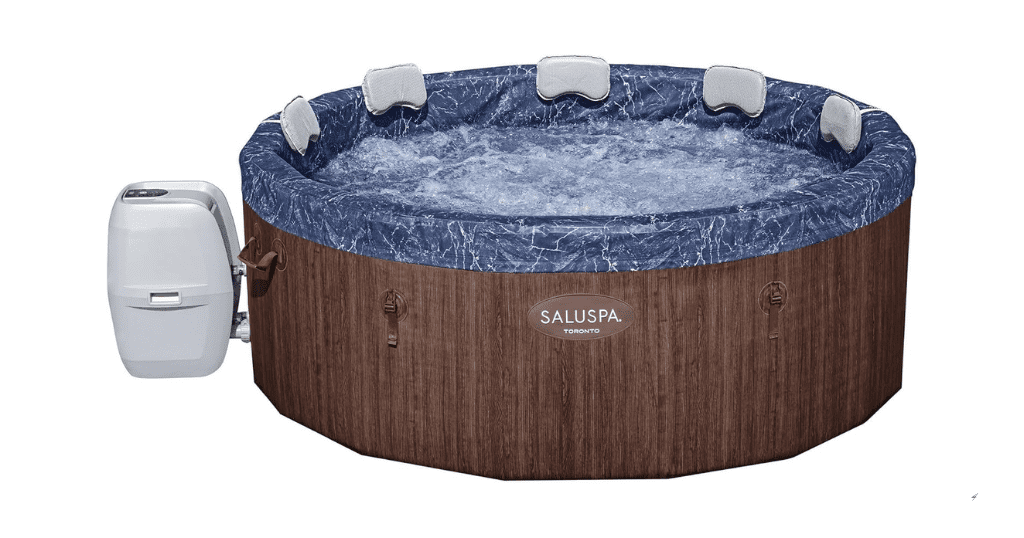

The Lay-Z-Spa Toronto AirJet Plus hot tub is a portable spa for buyers who want better insulation, firmer foam walls, and a more relaxing massage than a basic inflatable hot tub usually provides.
Its round 5–7 person layout, 180 AirJet Plus bubble system, EnergySense insulated cover, and ThermaCore foam wall construction make it a stronger pick than a basic inflatable hot tub for patios, gardens, and renters who want spa-style soaking without permanent installation.
This Lay-Z-Spa Toronto AirJet Plus hot tub review covers comfort, capacity, heating time, running costs, water care, and whether it’s the right portable hot tub for your space.
Disclosure: As an Amazon Associate I earn from qualifying purchases at no extra cost to you.
Quick Verdict: Is the Lay-Z-Spa Toronto AirJet Plus Worth It?
The Lay-Z-Spa Toronto AirJet Plus hot tub is a sensible buy for couples, small families, renters, and first-time spa buyers who want a sturdier portable hot tub for year-round garden use. Its ThermaCore foam walls feel firmer than standard air-filled inflatable hot tubs, help the water retain heat, and give the spa a more secure shape when people lean against the sides.
It’s not the right choice if you want acrylic spa-style hydrotherapy, directional water jets, roomy seating for seven adults, or water care that handles itself. The 180 AirJet Plus system creates a relaxing bubble massage, but it won’t target your back and shoulders like fixed hydrotherapy jets.
The main reason to buy the Toronto AirJet Plus is insulation. The main compromise is massage strength. For buyers comparing foam wall hot tubs with basic inflatable spas, the Toronto AirJet Plus offers a better balance of comfort, heat retention, winter protection, and portable spa use.
Lay-Z-Spa Toronto AirJet Plus Hot Tub at a Glance
| Spec | Detail |
|---|---|
| Type | Rigid foam wall portable hot tub |
| Listed capacity | Up to 7 people |
| Approximate dimensions | Around 75 inches across and about 27.5 to 30 inches high |
| Massage system | 180 AirJet Plus bubble jets, two intensity levels |
| Max temperature | 104°F (40°C) |
| Heating rate | Approximately 1.1°C to 1.6°C per hour, or roughly 2.2°F to 3.2°F per hour |
| Winter feature | Freeze Shield, designed to help protect internal components from freezing |
| App control | Bestway Smart Hub / Lay-Z-Spa WiFi app, depending on region |
| Cover | Reinforced insulated cover |
| Wall construction | ThermaCore foam panels with DuraPlus liner |
| Water care | ChemConnect chlorine dispenser, integrated filtration |
| Electrical Safety | Direct grounded/earthed outlet; no extension lead |
What Makes the Toronto Different From a Regular Inflatable Hot Tub?
Most portable spas use inflated air chambers for support. The Toronto uses interlocking ThermaCore foam panels under a DuraPlus liner, and that changes how the hot tub feels and how well it holds heat.
The foam walls give it a firmer, more stable feel than a balloon-style inflatable, even though it still isn’t the same experience as a fixed acrylic spa.
The biggest reason to choose the Toronto over a basic inflatable hot tub is heat retention. Its rigid ThermaCore foam walls feel sturdier when you sit back, and they’re made to hold warmth better than thin air-filled sides.
That doesn’t mean every home will see the same electricity savings, but it can help the tub feel less wasteful to run on cooler evenings.
For buyers searching for a foam wall hot tub, rigid portable spa, or inflatable hot tub alternative, the Toronto sits between thin-walled blow-up hot tubs and full acrylic spas.
Compared with a thinner air-walled inflatable, the practical difference should be most noticeable in the sturdier wall feel and better heat retention between soaks.
AirJet Plus Massage: What to Expect From the 180 Bubble Jets
The 180 AirJet Plus jets release bubbles from the floor and lower walls, with two intensity levels. The high setting creates the strongest bubble flow and is usually used for massage around the legs and lower back.
The low setting is gentler, so it’s better for a quiet soak or cooler evening.
If you’re coming from a basic inflatable hot tub with fewer jets, the wraparound bubble coverage feels like a clear upgrade. The bubble curtain is thicker, the footwell bubbles harder, and the two-level control gives you more flexibility than a single on-and-off button.
If you’re coming from an acrylic spa with directional hydrotherapy jets, the difference is noticeable. AirJet bubbles surround the body with warm, moving water. Hydrotherapy jets push focused streams of water at specific muscle groups.
If you want targeted deep tissue pressure, a bubble system won’t give you that. For relaxation, warmth, and a gentle full-body massage, the AirJet Plus does its job well.
Heating Time and Running Costs
According to the listing, the Toronto heats at approximately 1.1°C to 1.6°C per hour, or roughly 2.2°F to 3.2°F per hour, depending on ambient temperature and starting water temperature. Max water temperature is 104°F, the standard hot tub setting.
A cold fill can take most of a day to reach 104°F, especially in cooler weather. You can use the Bestway Smart Hub app to schedule heating overnight or during off peak electricity hours, so the water is ready by evening without paying peak rates all afternoon.
Winter is when running costs become more noticeable. Keeping the water at 104°F through freezing weather takes more electricity than holding heat in mild conditions, no matter which hot tub you buy.
The reinforced insulated cover helps between soaks, and the foam walls can reduce heat loss compared with thin air-filled walls.
Your actual monthly electricity use will depend on your climate, how often you use the hot tub, local electricity rates, and how consistently you keep the cover on.
Assembly, Placement, and Safety
The Toronto needs a flat, smooth, strong surface. A concrete pad, paving slabs, or a properly built deck are all reasonable options. Filled weight runs into the thousands of pounds because of the water volume, so balconies and older decks should be confirmed by a qualified professional before installation. A floor protector mat under the liner is a good extra step.
Bestway is explicit that the spa heater must be plugged directly into a properly earthed outdoor rated outlet that meets the load requirements on the warning label, in line with the manual and local electrical requirements. Extension cords and multi plug adaptors should not be used. If the outlet location doesn’t fit, an electrician should run a suitable circuit rather than improvising with a cord.
The first setup takes more care than unrolling a basic inflatable hot tub. It’s much easier with two people.
Let the liner sit in the sun before zipping it into place, especially in cooler weather. This helps the vinyl stay flexible and easier to work with.
The spa itself can go together fairly quickly once you understand the panel system, but filling takes longer. Lay-Z-Spa says setup can take around 10 minutes, with another 1–2 hours to fill depending on water pressure. For a first build, ensure you give yourself a bit of extra time.
Maintenance: Chemicals, Filters, and Water Care
Weekly upkeep on the Toronto is similar to most portable spas. The included ChemConnect dispenser releases chlorine evenly into the water, which reduces the guesswork of dosing by hand, but it doesn’t replace water care entirely.
Plan on testing pH, total alkalinity, and free chlorine with strips on a regular schedule. Rinse the filter cartridge under a hose every few days during heavy use. Replace cartridges when they stay discolored after rinsing. Filtration should run daily, and the Smart Hub app can schedule it alongside heating cycles.
Heavier use means more frequent water checks. After a group soak, expect to top up sanitizer and check pH the next day. None of this is hard once the rhythm is set, but anyone hoping for a hot tub that fully runs itself will find weekly water care a real ongoing chore.
Durability
The foam wall construction feels sturdier than air walled inflatables, and the DuraPlus liner is built to resist punctures. Long term durability depends on how the tub is treated.
Surface preparation, UV exposure, careful winter care, and consistent water chemistry all play a role. Storing the liner damp can encourage mold. Skipping chemistry checks can stress seams over time. Direct sun without a cover can soften the PVC and increase pressure inside the structure.
Lay-Z-Spa Toronto AirJet Plus Pros and Cons
Pros
- ThermaCore foam wall insulation: Designed to retain heat better than thin air-filled walls, with Bestway and retailer listings positioning it as more energy-efficient than a traditional inflatable spa.
- More rigid feel than basic inflatables: Sturdy enough to lean against, closer to a fixed spa than a blow up.
- Freeze Shield winter protection: Designed to keep internal components between roughly 42°F and 50°F so the tub can stay outside through cold months.
- WiFi app control: The Bestway Smart Hub app schedules heating, filtration, the power saving timer, and the massage system from a phone.
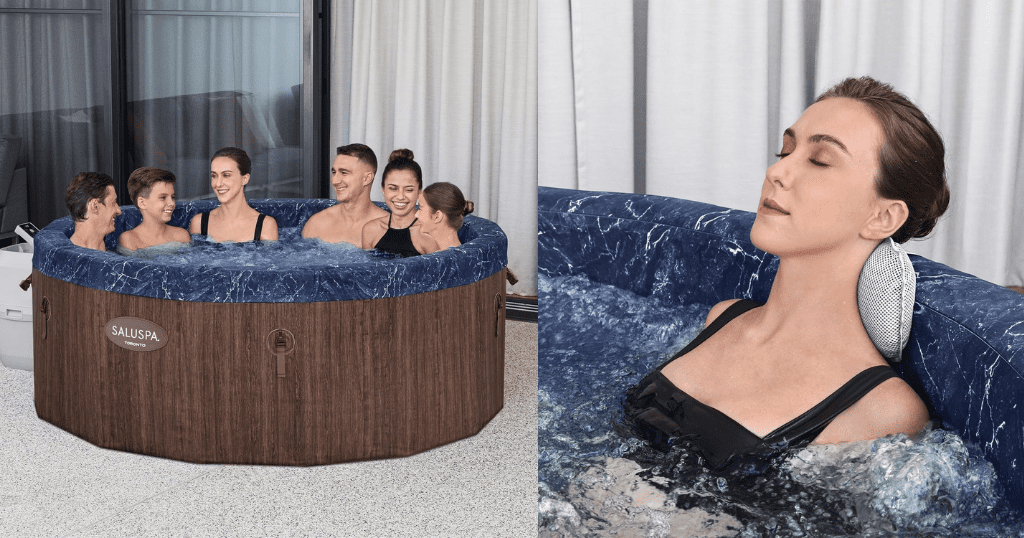
- Spacious feel: The open foot well and included padded pillows, where supplied by the retailer, make it feel better suited to longer soaks than a bare-bones inflatable.
- Relaxing 180 AirJet Plus bubbles: Two intensity levels deliver a wraparound massage on the legs and back.
Cons
- Bubble jets are not hydrotherapy jets: AirJet Plus is relaxing but doesn’t deliver directional deep tissue pressure.
- Heating takes time: A cold fill can take most of a day to reach 104°F in cooler weather.
- Running costs rise in winter: Holding 104°F through freezing weeks takes more electricity than mild season operation.
- Water care still required: Test strips, chlorine, pH adjustments, and filter rinsing are all ongoing tasks.
- Filled weight requires careful placement: Decks and balconies should be confirmed by a qualified professional.
Lay-Z-Spa Toronto AirJet Plus vs Regular Inflatable Hot Tubs
| Feature | Toronto AirJet Plus | Regular inflatable hot tub |
|---|---|---|
| Wall type | ThermaCore foam panels | Inflated air chambers |
| Heat retention | Stronger sidewall insulation | More heat loss through thin walls |
| Comfort | Rigid, fixed spa feel | Softer, balloon shaped feel |
| Winter usability | Freeze Shield designed for year round outdoor use | Often needs to be drained or stored in cold months |
| Assembly | More careful first build, two people recommended | Quicker first inflate, often one person possible |
| Long term ownership | Built for year round use with proper care | Often seasonal, may be replaced after fewer years |
| Best buyer | Year round users, cold climates, couples and families wanting a sturdier feel | Seasonal users, occasional soaks, mild climate buyers |
Lay-Z-Spa Toronto AirJet Plus vs Acrylic Hot Tub
The choice between a foam wall portable spa and a fixed acrylic hot tub comes down to commitment level and what kind of soak the household actually wants.
Choose the Toronto AirJet Plus if you want a lower commitment buy, full portability, WiFi app control, foam wall insulation, and a better than basic inflatable feel without committing to a permanent install.
Choose an acrylic hot tub if you want strong directional hydrotherapy jets, molded seating with proper neck and back support, a longer expected lifespan, and a permanent backyard centerpiece. Acrylic spas need an electrician, a prepared base, and a more involved installation, but the daily soak experience is meaningfully different from any bubble system.
For most households testing hot tub life for the first time, a foam wall portable spa like the Toronto is the lower risk way to find out whether a permanent spa is worth it later.
Final Verdict
For couples, small families, renters, and cold climate buyers who want a sturdier portable hot tub without a permanent install, the Lay-Z-Spa Toronto AirJet Plus earns its place. The ThermaCore foam walls feel closer to a fixed spa than air walled inflatables, the 180 AirJet Plus bubbles deliver a real two level massage, the WiFi app makes day to day use easier, and Freeze Shield gives cold climate owners a path to year round soaking.
The honest limits are worth keeping in mind. Heating from a cold fill takes most of a day. Running costs rise in winter. Bubble jets relax rather than target specific muscles. And weekly water care is part of ownership.
If you want acrylic spa hydrotherapy, and a permanent backyard centerpiece, this won’t be the right tub. If you want to try real hot tub life at home with foam wall insulation, app control, and year round flexibility, the Toronto AirJet Plus should land in the right place for the seasons ahead.
Check the latest price of the Lay-Z-Spa Toronto AirJet Plus on Amazon
Toronto AirJet Plus: FAQs
Is the Lay-Z-Spa Toronto AirJet Plus worth it?
For couples, small families, renters, and cold-climate buyers who want a sturdier portable spa, the Lay-Z-Spa Toronto AirJet Plus is a strong option. Its main strengths are the ThermaCore foam wall insulation, Freeze Shield winter protection, WiFi app control, and 180-jet AirJet Plus bubble massage.
How long does the Lay-Z-Spa Toronto AirJet Plus take to heat?
The Toronto isn’t a fill-and-soak-in-an-hour hot tub. Listed heating performance is around 1.1°C to 1.6°C per hour, and Lay-Z-Spa says a typical summer fill can take about 6–12 hours to reach 40°C. In cooler weather, expect longer. That makes the app timer useful to have on hand, because you can heat ahead instead of waiting around after filling.
Can the Lay-Z-Spa Toronto AirJet Plus be used in winter?
Yes, with Freeze Shield enabled, the spa powered on, and the manual followed. The system is designed to help protect internal components by keeping them between roughly 42°F and 50°F, but water care, power, cover use, and correct setup still matter.
Does the Lay-Z-Spa Toronto AirJet Plus have real jets?
The Toronto has 180 AirJet Plus bubble outlets, not directional hydrotherapy water jets. The bubbles create an all-around massage effect, but they won’t give you the focused pressure you’d get from a HydroJet Pro model or a fixed acrylic spa.
Can you leave the Lay-Z-Spa Toronto outside all winter?
Yes, with Freeze Shield enabled. The system is designed to keep internal components from freezing by holding internal temperatures between roughly 42°F and 50°F. A sheltered location helps where possible, the insulated cover should stay on between soaks, and water care continues year round to protect the liner and components.
Does the Lay-Z-Spa Toronto need a special outlet?
The spa heater must be connected directly to a properly earthed outdoor rated outlet that meets the load requirements on the warning label, following the manual and local electrical codes. Bestway specifies that extension cords and multi plug adaptors should not be used. If the outlet location doesn’t fit, a qualified electrician should install a suitable circuit before the tub is filled.
Is the Toronto better than a normal inflatable hot tub?
For most buyers wanting year round use, a sturdier feel, and stronger heat retention, yes. The ThermaCore foam wall construction holds heat better than thin air walls, the structure feels closer to a fixed spa, and Freeze Shield supports cold climate use. A basic inflatable is fine for mild weather seasonal soaking, but the Toronto is the more capable foam wall hot tub option for daily use.