
Most people think measuring distance for hot tub placement is straightforward until they actually stand in their backyard with a tape measure and realize they’re not entirely sure where to start or end their measurements.
I’ve seen homeowners measure from the wrong points, electricians argue about where the “inside wall” technically begins, and DIY installers completely miss critical measurement angles that lead to failed inspections. Knowing what the 5 foot rule for hot tubs needs is only half the battle.
Actually measuring it correctly in real-world conditions, with uneven terrain, existing structures, and complex electrical requirements, is where things get genuinely tricky.
Proper measurement ensures your investment stays protected, your family stays safe, and you don’t end up tearing out a freshly poured concrete pad because you measured from the wrong reference point. Accurate measurements save you from the nightmare scenario where an inspector shows up, pulls out their own tape measure, and finds you’re six inches short of compliance.
Once you understand the specific reference points, measurement techniques, and common scenarios that complicate accurate measuring, the process becomes much more manageable.
Hot Tub Clearance Planner
Estimates only. Codes and required measurement methods vary by location and hot tub model. Always verify distances on-site and confirm compliance with your local AHJ/inspector and a licensed electrician before installing.
Understanding Reference Points for Measurement
Before you pull out any measuring tools, you need to know exactly where your measurements should start and end. Building codes use specific terminology that doesn’t always align with how we naturally think about measuring distance.
When codes specify the 5 foot rule for hot tubs from structures, they’re referring to the shortest possible distance between any part of the hot tub structure and any part of the building. You’re measuring from the outermost edge of your hot tub shell to the nearest point on your house structure.
The hot tub shell is what matters here, not the equipment cabinet, not the steps, but the actual tub body.
For most homes, this reference point will be your siding, but it could also be a foundation wall, deck support post, or any permanent structural component. You’re measuring horizontally across the ground plane, not in a diagonal line through the air.
If you have sloped terrain between your house and hot tub location, you’ll need to account for this properly.
Think of it like measuring on a flat map as opposed to following the actual contours of your yard.
For electrical measurements, particularly GFCI outlets and disconnect switches, the reference point changes to the “inside wall” of the hot tub. This terminology confuses a lot of people because they think it means the interior surface you’d touch while sitting in the water.
It refers to the inner rim or lip where the tub shell meets the water’s surface. On most hot tubs, this is the seating area edge where you’d rest your arms.
The disconnect switch measurement uses “horizontal distance,” which explicitly excludes any vertical component. If your disconnect is mounted on a wall above ground level and your hot tub is recessed into a deck, you’re measuring the horizontal span between them, not the diagonal distance through space.
This distinction matters because measuring the diagonal would give you a longer measurement than what the code actually needs you to maintain.
Tools and Equipment for Accurate Measurement
To measure hot tub placement accurately, use tools that reduce guesswork and measurement errors. A 50-foot tape measure is better than a 25-footer because you can take longer, single-run measurements instead of stitching distances together.
A laser distance measurer makes hot tub clearance measurements faster and more precise when you’re working alone, especially for elevated targets like overhead power lines or second-story points.
For layout and documentation, bring landscape marking paint or flags (color-code zones like the 5-foot setback, electrical clearances, and property lines), plus stakes and string to outline the hot tub footprint.
If your yard isn’t level, a 4–6 foot level helps you measure true horizontal distance instead of following the slope.
Don’t overlook the value of a smartphone with a compass and measurement apps. Modern phones have surprisingly accurate built-in tools that can help verify angles, document site conditions with photos, and even create rough dimensional drawings of your planned layout.
I particularly like apps that let you overlay measurements directly onto photos, they’re excellent for sharing plans with electricians and inspectors.
Step-by-Step Measurement Process for Structural Distance
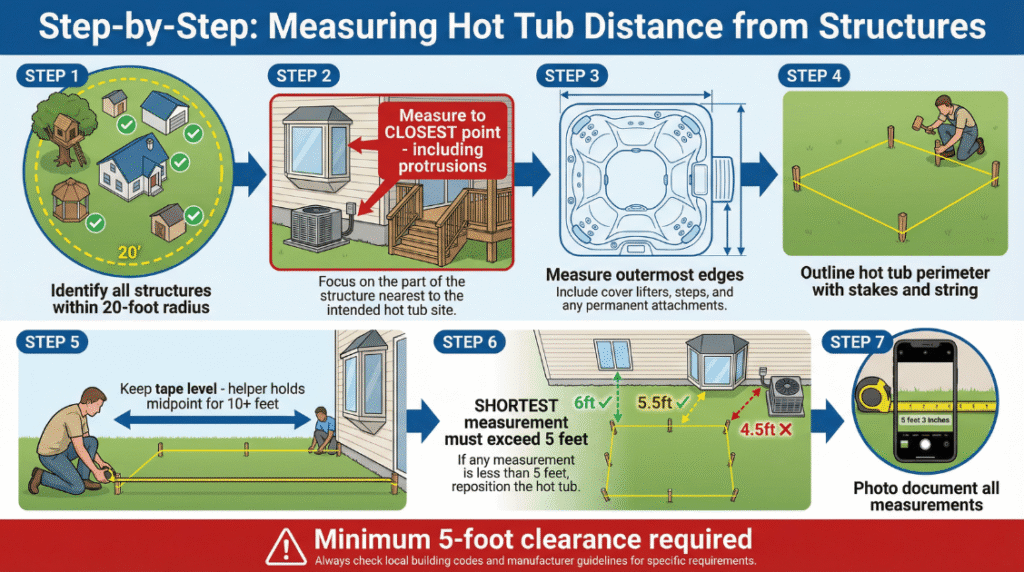
Step-by-step (see infographic above): Start by scanning a 20-foot radius around your proposed spa location and list every permanent structure that could be the “closest point” (house walls, bay windows, deck posts, stairs, HVAC equipment, sheds, gazebos, and similar fixed features). The clearance is always measured to the nearest protrusion, not just the main wall.
Next, outline the hot tub’s true footprint on the ground with stakes and string, using the outermost edges of the tub and any permanent attachments (built-in steps, cover lifter brackets, molded benches, or a protruding cabinet).
Measure horizontally from the string perimeter to the closest point on the structure, keeping the tape level and supported if the span is long. Repeat from multiple points around the perimeter, because the only number that matters is the shortest measurement.
Photograph each measurement with the tape clearly visible so you have proof for permit review and inspection.
Measuring Electrical Clearances and GFCI Placement
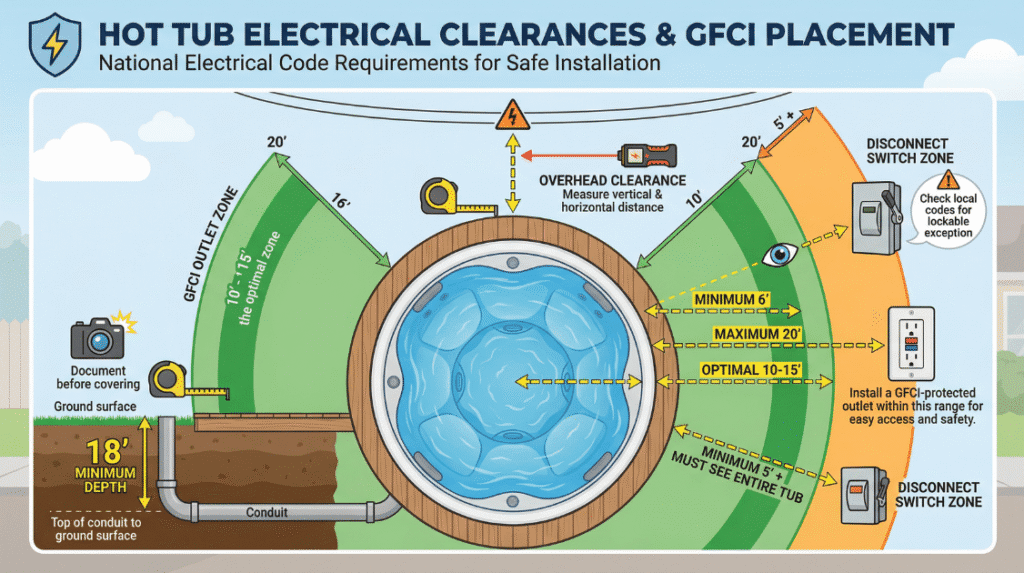
Electrical clearances (see infographic above): Electrical spacing is measured from specific reference points, so accuracy matters.
For a GFCI-protected outlet, measure horizontally from the hot tub’s inside wall (waterline rim) to the center of the receptacle.
The common requirement is 6–20 feet, with an “easy to live with” target of 10–15 feet for access without keeping electricity too close to splash and steam.
For the disconnect switch, measure horizontally from the inside wall and keep it at least 5 feet away, plus within sight of the hot tub (you should be able to see the tub clearly from the disconnect location). If anything blocks the view—fence, hedge, wall—double-check your local rules, since “lockable” exceptions vary.
Also account for overhead power line clearance (you’ll need both vertical and horizontal checks—laser tools help) and buried conduit depth, which is commonly at least 18 inches.
Photograph measurements like trench depth and outlet/disconnect locations before anything gets covered, since inspectors often want to see proof.
Accounting for Sloped Terrain and Uneven Ground
Measuring hot tub clearances on flat ground is easy, but most yards slope. Since hot tub codes use horizontal distance, you have to remove the vertical “rise” from your measurement.
- Gentle slopes (under ~5°): you can usually measure along the surface with minimal error, as long as you’ve built in extra clearance.
- Moderate to steep slopes: use a method that gives true horizontal distance:
- String + line level (stake method): drive a stake at the hot tub location and one at the house, run string between them, level the string with a line level, then measure along the level string for horizontal distance (and measure the vertical drop separately if needed).
- Straight board + carpenter’s level: extend a straight board toward the house and lift until level; measure along the level board for true horizontal clearance.
- Laser distance measurer with inclinometer: measures distance and angle and calculates horizontal distance automatically—worth it for significant slopes.
Finally, measure from the finished grade, not today’s ground level. If you’re excavating for a level pad, measure from the planned finished surface; if you’re building up with gravel or a raised base, measure from the final elevated height where the hot tub will sit.
Measuring Property Lines and Setback Requirements
Property line measurements can get legally messy, because the biggest problem is often not knowing the exact boundary.
A fence or hedge might look like the line, but without a recent property survey, it’s often just a guess. If your hot tub placement is anywhere near a boundary, get (or find) a survey—many homeowners already have one in their closing documents. Typical surveys run about $300–$1,000, which is far cheaper than relocating a spa after a setback violation.
If your lot has survey markers, measure from them. They’re usually metal stakes or concrete monuments at the corners and may be buried under soil or vegetation, so you might need a metal rod to probe and locate them.
Once you know the boundary, measure hot tub setbacks the same way you measure from structures: run a string line along the property line, then measure a perpendicular distance from that line to the hot tub footprint.
Many areas require something like 5 ft side setbacks and 10–15 ft rear setbacks, but local rules vary a lot. Front yard setbacks are often strict, and some jurisdictions don’t allow hot tubs in front yards at all—corner lots and odd-shaped lots can create multiple “front yard” zones.
Also check easements (utility, drainage, access). These show on your survey or deed and can restrict where a hot tub can go. Measure from easement boundaries just like property lines and confirm restrictions with your local building department and utility company.
Common Measurement Mistakes to Avoid
These are the errors that most often cause failed hot tub clearance checks and surprise inspection issues:
- Measuring from the wrong starting point
Don’t measure from the equipment cabinet or removable steps. Measure from the outermost point of the hot tub shell, including any permanently attached features. - Only measuring one direction
A spot that looks like 7 feet from one corner can be under 5 feet from another if the tub is angled. Measure from at least three points around the footprint and use the shortest distance. - Letting the tape sag
A long tape that droops can shave inches off your true hot tub setback measurement. Keep the tape taut and level, and have a helper support the midpoint on longer runs. - Not outlining the full hot tub footprint first
Measuring “to the center point” on the ground isn’t enough. A 7-foot tub placed on that point can push the near edge too close. Stake and string the actual perimeter, then measure from that outline. - Rounding up to claim compliance
If you measure 59.5 inches, calling it 60 inches (5 feet) can put you short. For clearance and setback measurements, round down to the nearest inch. - Measuring to the wrong part of the house
The nearest point might be a bay window, deck post, stair stringer, or HVAC unit, not the siding. Always measure to the closest protrusion. - Ignoring weather effects on accuracy
Tape measures can expand/contract slightly in extreme heat or cold. It’s a small effect, but if you’re tight on clearance, recheck measurements in moderate conditions or give yourself extra margin.
Verification Techniques and Double-Checking Methods
Before you pour a pad or start wiring, use a few quick checks to confirm your hot tub placement measurements are accurate:
- Triangulation (locks in the location): Measure from two fixed points on the house (like two corners) to the same point on the hot tub footprint, then measure between the two house points. If someone re-measures and gets the same three distances, your layout is verified.
- Diagonal cross-check (for square/rectangular footprints): After staking the four corners, measure corner-to-corner diagonals. If the footprint is square/true rectangle, both diagonals should match. If they’re off by more than about an inch, adjust the stakes.
- Photo documentation (proof for permits/inspection): Take photos with the tape clearly visible, and include a quick label in-frame (phone note, paper, or whiteboard) like: “NW corner to siding: 72 in.” This helps during permit review and avoids disputes later.
- Independent second measurement (catches human error): Have someone else measure the same clearances without seeing your numbers. If your results match, you’re in a good spot. If not, re-measure until you agree.
- Surveyor confirmation (best for tight setbacks): If you’re close to property lines or clearances are tight, a land surveyor can provide certified distances and a site sketch that carries weight if questions come up.
- Temporary mock-up (real-world sanity check): Use string, cardboard, lumber, or an inflatable pool to mock the footprint. Walking around it helps confirm the space feels workable and your clearance measurements translate to reality.
FAQs
How far does a GFCI outlet need to be from a hot tub?
The GFCI outlet must be at least 6 feet from the inside wall of the hot tub, measured horizontally from the water’s edge to the outlet receptacle. The most distance allowed is 20 feet.
I recommend placing it between 10 and 15 feet for convenience and safety.
Can I place a hot tub directly against my house?
No, most building codes need at least 5 feet of horizontal clearance between the hot tub’s outer shell and any permanent structure including your house. This clearance requirement exists for structural protection, maintenance access, and safety reasons.
Placing a hot tub directly against your house violates code and creates moisture problems.
What happens if my hot tub is too close to the property line?
If your hot tub violates setback requirements, your local building department can issue a stop-work order, fine you, or need you to relocate or remove the hot tub. Setback violations can also create problems when selling your home, as they’ll appear in allow searches and may affect home insurance coverage.
How do I find my property lines without a survey?
You can look for property markers at corner points, which are typically metal stakes or concrete monuments buried a few inches underground. Your property deed may include dimensions you can measure from street or other reference points.
However, for accurate placement near boundaries, hiring a surveyor is the most reliable option.
Do I measure to the siding or the foundation of my house?
You measure to whichever part of the house structure is closest to the hot tub. This could be siding, foundation, deck supports, bay windows, or any other permanent structural component.
The code needs distance from any part of the structure, so you need to identify and measure to the nearest point.
Can a hot tub sit on sloped ground?
Hot tubs must sit on a level surface for proper function and safety. If your installation site is sloped, you’ll need to create a level pad through excavation, building up with gravel and pavers, or constructing a level deck.
When measuring clearances on sloped terrain, always measure horizontal distance, not slope-following distance.
How far does a hot tub disconnect switch need to be?
The disconnect switch must be at least 5 feet from the hot tub’s inside wall, measured horizontally. It also must be within line of sight of the hot tub, meaning you can see the tub from the disconnect location without obstruction.
Some jurisdictions allow out-of-sight placement if the disconnect is lockable in the open position.
Do hot tub steps count for clearance measurements?
Yes, any permanently attached component of the hot tub counts when measuring clearances. If your hot tub has built-in steps or a molded bench that extends beyond the main shell, measure from the outermost point of those features.
Removable accessories like separate step stools typically don’t count.
What tools do I need to measure hot tub placement?
You need at minimum a 50-foot tape measure, stakes, string, and marking paint. A 4-foot level helps with sloped terrain. A laser distance measurer makes the job significantly easier and more accurate, especially for long distances or elevated measurements.
A smartphone with camera and measurement apps provides good documentation.
Disclaimer: This article is for general informational purposes only and is not legal, electrical, or building advice. Hot tub clearance rules (including “5-foot” setbacks), electrical requirements, and permit standards vary by state, county, and municipality, and may differ based on your hot tub model and site conditions. Always follow the manufacturer’s installation instructions and consult your local Authority Having Jurisdiction (building department/inspector) and a licensed electrician or qualified contractor before installing, wiring, or excavating. Measurements and examples are illustrative; confirm all distances on your property.