
Keeping your spa water clean and comfortable isn’t guesswork. Regular jacuzzi water testing gives you the information you need to catch problems early—before cloudy water, skin irritation, or equipment issues show up.
Testing tells you whether your sanitizer is working, whether your pH is in range, and whether anything else needs attention. It takes a few minutes, and once you know what to look for, it becomes second nature.
This guide covers what to test, how to choose a test kit, how to interpret your results, and what to do when something’s off.
Disclosure: As an Amazon Associate I earn from qualifying purchases at no extra cost to you.
Quick Start Checklist for New Spa Owners
If you’re new to caring for a Jacuzzi, start here:
- Get a test kit or spa photometer that measures pH, alkalinity, sanitizer, and calcium hardness
- Test your water before each soak and twice a week minimum
- Write down your results in a notebook or app
- Adjust alkalinity first, then pH, then sanitizer
- Wait 30 minutes after adding anything before retesting
- Drain and refill every 3 to 4 months depending on use
Once you’ve tested a few times, the process becomes quicker and easier.
What to Test in Jacuzzi Water Testing
Each parameter below affects something different. Some readings keep the water safe, while others help protect your equipment and keep the water feeling comfortable.
Free Chlorine or Bromine
This is your sanitizer—the chemical that kills bacteria, viruses, and other contaminants. Free chlorine or free bromine is the active form that’s available to disinfect.
Typical guidelines for free chlorine range from 3 to 5 ppm. For bromine, the range is usually 4 to 6 ppm. These ranges can vary slightly depending on your sanitizer system and manufacturer recommendations.
pH
pH measures how acidic or alkaline your water is. Water that’s too acidic can irritate skin and corrode metal parts. Water that’s too alkaline reduces sanitizer effectiveness and can cause scale buildup.
The typical target range is 7.2 to 7.8. Most hot tub manufacturers recommend staying between 7.4 and 7.6 for best results. You can read more about how to adjust pH levels for your spa in this article.
Total Alkalinity
Total alkalinity acts as a buffer for pH. When alkalinity is in range, your pH stays stable. When it’s off, your pH will bounce around no matter how many times you adjust it.
Typical guidelines suggest keeping total alkalinity between 80 and 120 ppm, though some systems work better at the higher or lower end of that range.
Calcium Hardness
Calcium hardness measures the amount of dissolved calcium in your water. Too little calcium can cause corrosion of metal components and etching of plaster or acrylic surfaces. Too much calcium leads to scale buildup on the shell, plumbing, and heater.
The typical range is 150 to 250 ppm for acrylic spas and 200 to 400 ppm for plaster or concrete spas. Check your owner’s manual for specific guidance.
Cyanuric Acid
Cyanuric acid is a stabilizer that protects chlorine from breaking down in sunlight. It’s mainly relevant for outdoor spas that use dichlor or trichlor chlorine products, which contain stabilizer.
If you use these products, your cyanuric acid can build up over time. The typical target range is 30 to 50 ppm. Levels above 100 ppm can slow down chlorine’s effectiveness, which means you may need to drain and refill.
Indoor spas and spas using bromine or non-stabilized chlorine typically don’t need to monitor this.
Total Dissolved Solids
Total dissolved solids (TDS) measures everything dissolved in your water—salts, minerals, chemicals, and organic waste. As you add products and bathers use the spa, TDS gradually increases.
High TDS can make the water feel flat, reduce sanitizer efficiency, and cause foaming. Most manufacturers recommend keeping TDS below 1500 ppm above your starting fill water level.
This parameter doesn’t need weekly testing. Check it every month or two, or when you notice persistent water quality issues that don’t respond to normal adjustments.
Jacuzzi Water Testing Results Explained
| Parameter | What It Affects | Signs It’s Too Low | Signs It’s Too High |
|---|---|---|---|
| Free Chlorine/Bromine | Sanitation and bacteria control | Cloudy water, algae, odor, illness risk | Strong chemical smell, skin/eye irritation, bleached swimsuits |
| pH | Sanitizer effectiveness, comfort, equipment | Corrosion, etching, eye irritation, rapid sanitizer loss | Scale, cloudy water, reduced sanitizer effectiveness, skin irritation |
| Total Alkalinity | pH stability | pH swings, corrosion, staining | Cloudy water, scale, difficulty adjusting pH |
| Calcium Hardness | Equipment protection, water feel | Corrosion, foam, etching of surfaces | Scale on shell and jets, cloudy water, rough surfaces |
| Cyanuric Acid | Chlorine protection from UV | Chlorine degrades quickly in sunlight | Chlorine works slowly, harder to maintain sanitizer levels |
| Total Dissolved Solids | Water clarity and feel | Not applicable | Flat-feeling water, foaming, difficulty balancing chemistry |
Best Tools for Jacuzzi Water Testing
You have three main options for testing your spa water. Each has strengths and tradeoffs.
Test Strips
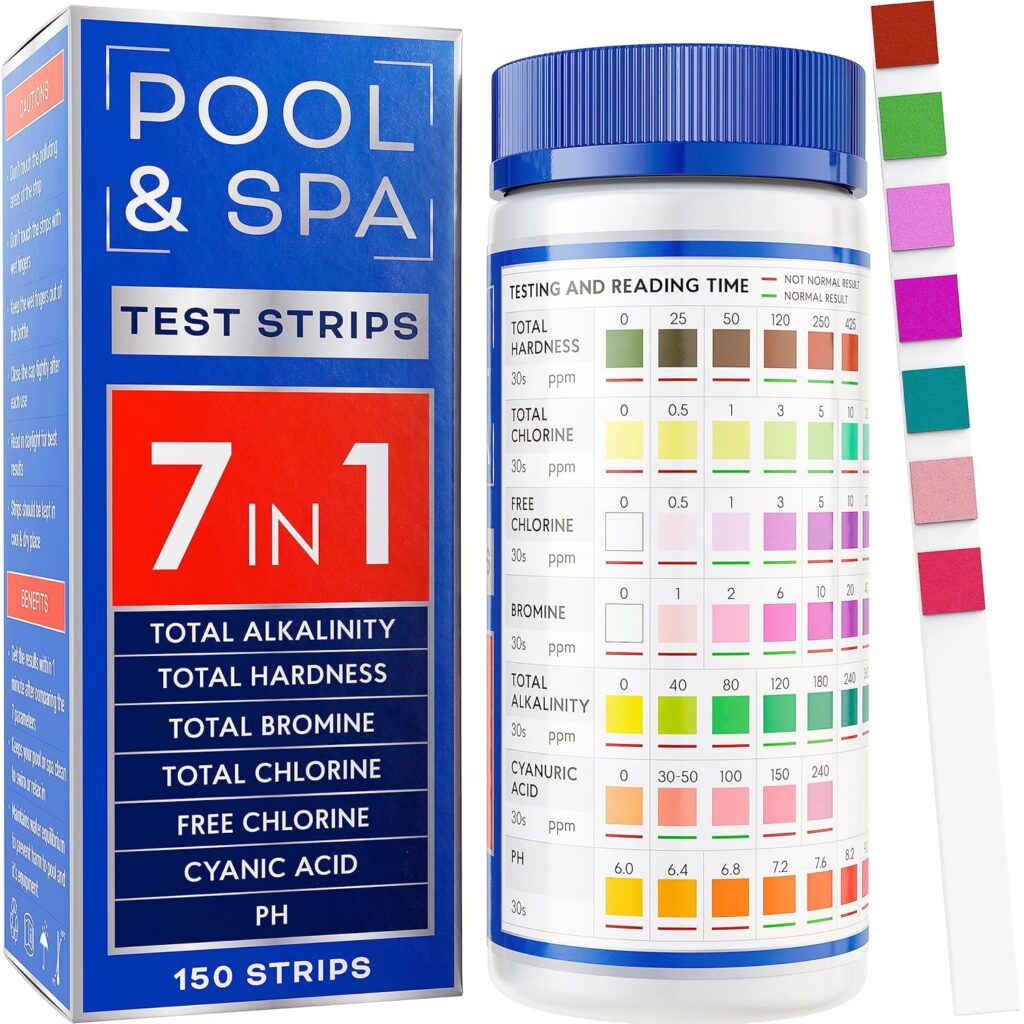
Test strips are plastic strips with small pads that change color when dipped in water. You dip the strip, wait a set amount of time, and compare the colors to a chart.
Most strips test pH, total alkalinity, and free chlorine or bromine on one strip. Some also include calcium hardness and cyanuric acid.
Pros:
- Fast and simple to use
- No mixing or measuring required
- Affordable and widely available
- Good for routine checks
Cons:
- Less accurate than liquid tests
- Can be harder to read if colors are close
- Sensitive to moisture and light—strips degrade if the bottle isn’t sealed
- Doesn’t distinguish between free and total chlorine
Best for: Weekly testing and quick checks before soaking. Good for most spa owners who want simplicity.
Liquid Drop Test Kits
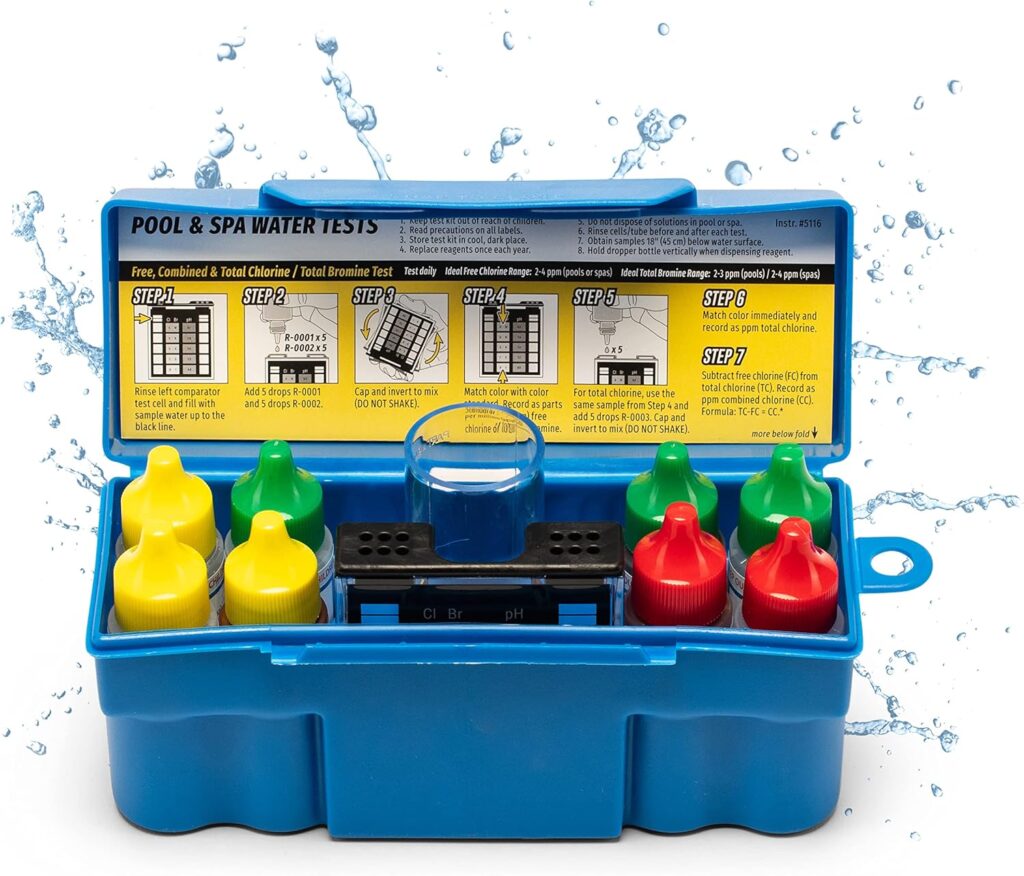
Liquid drop kits use reagent drops that you add to a water sample. The water changes color, and you compare it to a chart to read the result.
Most kits include separate tests for pH, alkalinity, chlorine, and sometimes bromine. Higher-quality kits can measure free chlorine and total chlorine separately, which helps you detect combined chlorine (chloramines).
Pros:
- More accurate than test strips
- Easier to see exact color matches
- Can test for combined chlorine
- Reagents last longer when stored properly
Cons:
- Takes slightly longer than strips
- Requires measuring and mixing
- Vials and bottles need rinsing between tests
- Can be messy if you spill
Best for: Spa owners who want more precision, anyone troubleshooting water problems, or people who prefer more detailed information about chlorine levels.
Shop Liquid Drop Kits on Amazon
Digital Photometers
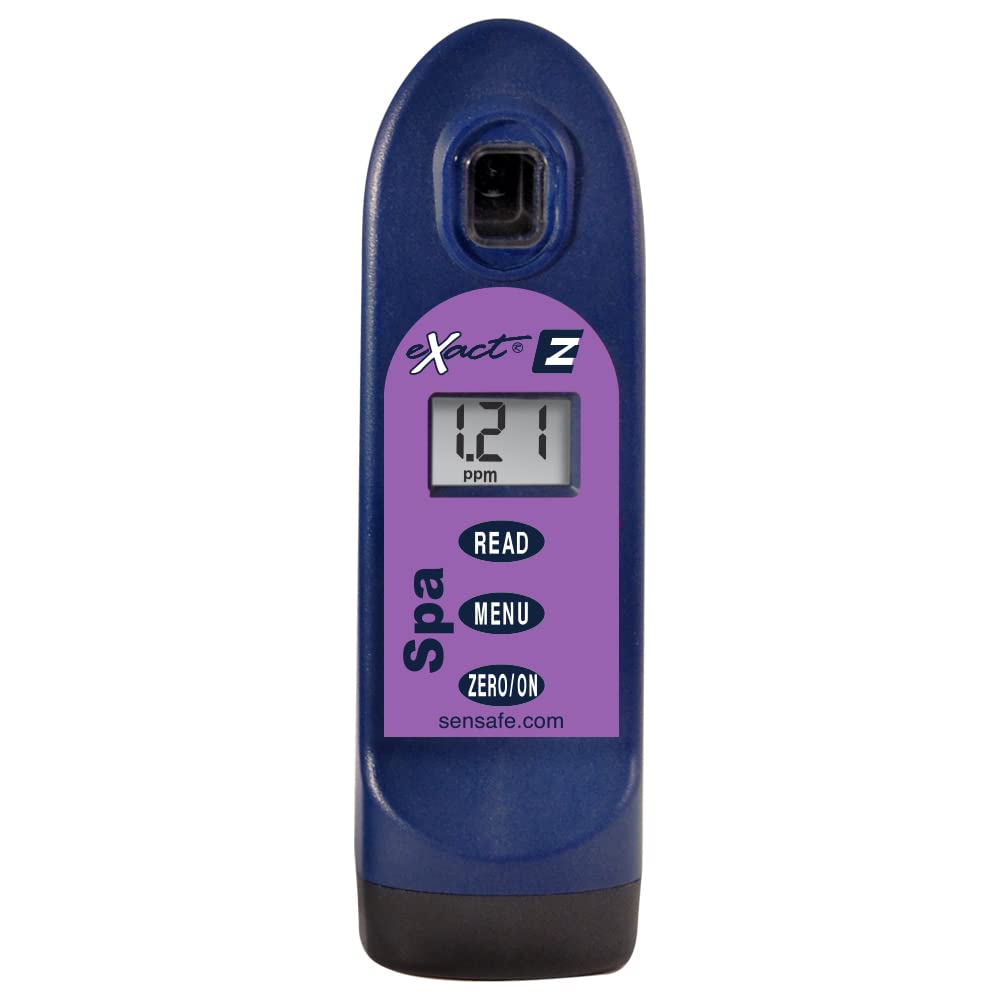
Digital photometers use light sensors to measure chemical concentrations. You add a reagent tablet or powder to a water sample, insert the sample into the device, and get a digital readout.
Pros:
- Most accurate option
- Removes color-matching guesswork
- Some models store test history
- Useful for precise troubleshooting
Cons:
- Higher upfront cost
- Requires calibration
- Still uses reagent tablets or powders
- More steps than strips
Best for: People who manage multiple spas, those who want lab-level accuracy, or anyone who struggles with color vision.
Shop Digital Photometers on Amazon
Which One Should You Use?
For most spa owners, test strips are great for day to day checks. It still helps to keep a liquid drop kit around for troubleshooting, or for double checking strip results when something seems off.
If you are new to spa care, start with strips. Once the routine feels familiar, you can decide if you want the extra precision.
Step-by-Step Jacuzzi Water Testing Process
Follow these steps for accurate results every time.
When to Test your Jacuzzi Water
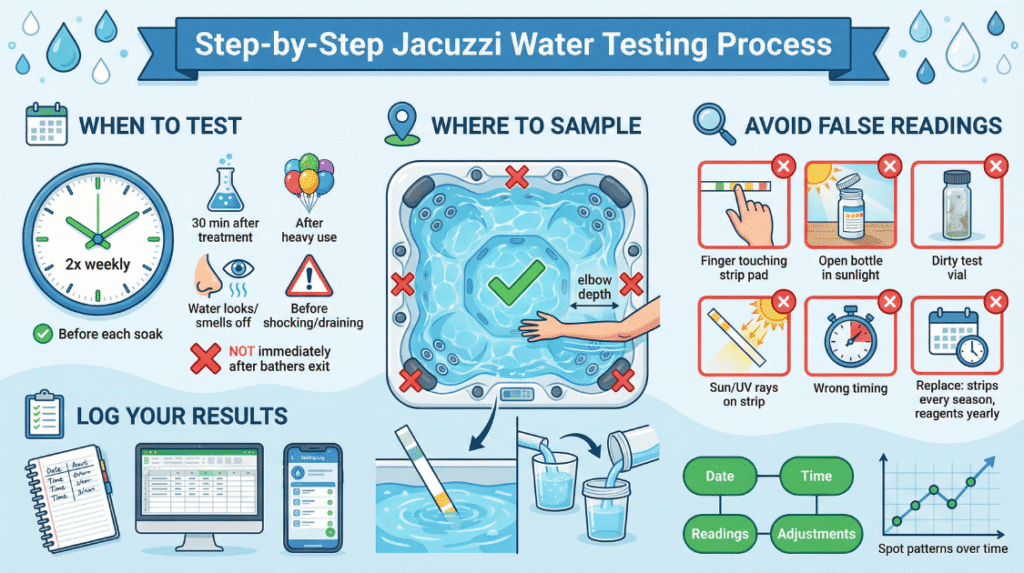
Test your spa water at least twice a week, and always before soaking.
Also test:
- After adding any treatment product—wait at least 30 minutes for circulation
- After heavy use or a party
- When the water looks or smells different than usual
- Before shocking or draining
Avoid testing immediately after someone gets out. Oils, lotions, and contaminants from bathers can temporarily skew readings.
Where to Take Your Sample
Take water from elbow depth in the center of the spa, away from jets and return lines. Surface water and water near jets can contain concentrated pockets of treatment products or debris.
If using test strips, dip the strip directly into the spa at this depth. If using a liquid test kit, collect a sample in a clean container—rinse the container with spa water first to avoid contamination.
How to Avoid False Readings
- Don’t touch the test pads on strips with your fingers
- Keep test strip bottles tightly sealed and stored in a cool, dry place
- Rinse liquid test vials thoroughly between uses
- Don’t test in direct sunlight—UV light can fade colors
- Follow timing instructions exactly—comparing colors too early or too late throws off accuracy
- Replace test strips every season and liquid reagents every year
How to Log Your Results
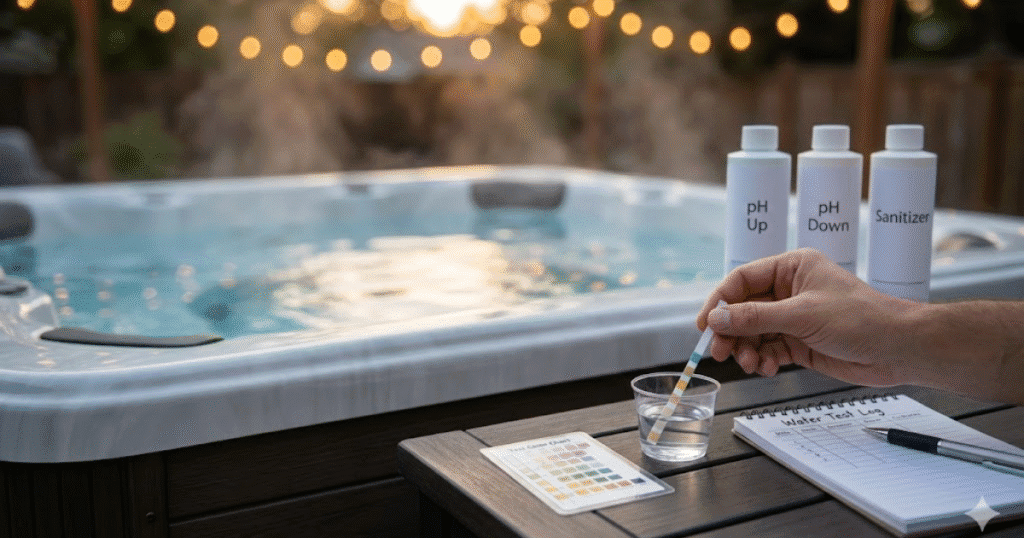
Write down your results every time you test. A simple notebook works, or you can use a spreadsheet or spa maintenance app.
Track the date, time, each parameter reading, and any adjustments you made. Over time, patterns emerge that help you anticipate problems and fine-tune accordingly.
How Often to Test Your Spa Water
Testing frequency depends on how much you use your spa and how many people soak in it.
Light use (1 to 2 people, 2 to 3 times per week): Test twice a week minimum. Test before each soak if you’re new to spa care or troubleshooting an issue.
Moderate use (2 to 4 people, 4 to 5 times per week): Test three times a week. Test daily during periods of heavy use.
Heavy use (multiple people daily, frequent guests): Test daily. Check sanitizer levels before and after group soaks.
Special situations:
- Test after adding any chemical and waiting 30 minutes
- Test after refilling your spa and balancing startup chemistry
- Test weekly even if your spa sits unused—chemistry can still drift
More frequent testing doesn’t mean more work. Once you’re in a rhythm, each test takes less than five minutes.
How to Interpret and Adjust Jacuzzi Water Testing Results
When your test shows something out of range, adjust in this order. Making changes in the wrong sequence wastes time and product.
Step 1: Adjust Total Alkalinity First
Total alkalinity stabilizes pH. If alkalinity is off, your pH will keep drifting no matter how many times you adjust it.
If alkalinity is low, add an alkalinity increaser (sodium bicarbonate). If it’s high, add a pH decreaser (sodium bisulfate or muriatic acid) in small doses—lowering alkalinity also lowers pH, so go slowly.
Step 2: Adjust pH Second
Once alkalinity is stable, adjust pH if needed. Use a pH increaser (sodium carbonate) to raise it or a pH decreaser to lower it.
Make small adjustments—add half the recommended dose, circulate for 30 minutes, and retest. It’s easier to add more than to overshoot and correct backward.
Step 3: Check and Adjust Sanitizer
With alkalinity and pH in range, check your free chlorine or bromine level. Add sanitizer if it’s low.
If your sanitizer reads high but the water smells strongly of chlorine, test for combined chlorine. A strong chlorine smell actually means you don’t have enough free chlorine—it’s the smell of chloramines (combined chlorine), which are ineffective at sanitizing. Shock the spa to break down chloramines and restore free chlorine.
Step 4: Circulate and Retest
After making adjustments, run your spa’s circulation pump for at least 30 minutes to mix everything thoroughly. Then retest to confirm your changes worked.
If readings are still off, repeat the process with smaller adjustments. Patience prevents overshooting.
When to Adjust Calcium Hardness
If calcium hardness is low, add a calcium hardness increaser. If it’s high, the only fix is dilution—drain some water and refill with fresh water that has lower calcium content.
Calcium changes slowly, so you typically only need to adjust this during startup or after a refill.
Troubleshooting Common Spa Water Problems
Use your test results to diagnose these issues:
Cloudy Water
Test first: pH, alkalinity, sanitizer, calcium hardness
Common causes:
- Low sanitizer—bacteria or algae multiplying
- High pH or alkalinity—sanitizer isn’t working efficiently
- High calcium hardness—mineral precipitation
- Dirty filter—water isn’t being cleaned
- High TDS—too much dissolved material
Fix: Adjust pH and alkalinity first, then shock if sanitizer is low. Clean or replace your filter. If chemistry is balanced but water stays cloudy, check TDS and consider a partial drain.
Strong Chlorine Smell
Test first: Free chlorine and total chlorine (if your kit allows)
Common causes:
- Combined chlorine (chloramines)—chlorine has bonded with contaminants and is no longer effective
- Ironically, this smell means you need more chlorine, not less
Fix: Shock the spa to break down chloramines and restore active chlorine. Test again after circulation. If the smell persists, consider switching to non-chlorine shock or draining and refilling.
Foaming
Test first: pH, alkalinity, TDS
Common causes:
- Soaps, lotions, or detergents in the water
- Low calcium hardness—soft water tends to foam more
- High TDS—buildup of dissolved organics
Fix: Ask bathers to shower before soaking and avoid using lotions beforehand. Add a defoamer as a temporary fix. If foaming continues, check calcium hardness and TDS. Persistent foam often means it’s time to drain and refill.
Skin or Eye Irritation
Test first: pH, free chlorine or bromine, combined chlorine
Common causes:
- Low or high pH—out-of-range pH irritates skin and eyes
- High sanitizer levels—too much chlorine or bromine
- Combined chlorine (chloramines)—ineffective sanitizer that causes irritation
Fix: Adjust pH to the 7.4 to 7.6 range. If sanitizer is high, leave the cover off and let it dissipate, or drain some water and refill. If combined chlorine is present, shock the spa.
Scale Buildup
Test first: pH, calcium hardness, alkalinity
Common causes:
- High pH or alkalinity—minerals precipitate out of solution
- High calcium hardness—too much dissolved calcium
- Hard fill water—your tap water has high mineral content
Fix: Lower pH and alkalinity if they’re high. If calcium hardness is above range, dilute by draining some water and refilling. Use a scale preventer product if your fill water is naturally hard. Clean existing scale with a spa surface cleaner.
Algae Growth
Test first: Free chlorine or bromine, pH
Common causes:
- Low sanitizer—not enough active chlorine or bromine to kill algae
- High pH—sanitizer loses effectiveness above 7.8
- Poor circulation—stagnant water in pipes or corners
- Contaminated filter
Fix: Shock the spa immediately. Brush the spa shell to loosen algae. Clean or replace the filter. Adjust pH if needed. Run the pump continuously until water clears. Algae is rare in well-maintained hot tubs—if it appears, your sanitizer routine needs tightening.
When to Drain and Refill Your Spa
Even with perfect chemistry, you’ll eventually need to drain and refill. Water accumulates dissolved solids that can’t be filtered out or adjusted with chemicals.
Drain and refill every 3 to 4 months for average use. Heavy use may require more frequent changes. Light use may allow you to stretch to 4 months.
Signs it’s time:
- TDS is 1500 ppm or more above your fill water baseline
- Water feels flat, dull, or filmy despite balanced chemistry
- Foaming persists even after adjusting chemistry
- Cyanuric acid is above 100 ppm (for chlorine spas)
- You can’t get chemistry stable no matter what you adjust
- Water has a lingering odor that doesn’t go away after shocking
When you refill, test your fill water before balancing. Knowing your starting calcium hardness and TDS gives you a baseline to track against.
Safety Guidelines for Spa Water Testing and Chemical Handling
Testing is safe when done correctly, but handling treatment products requires care.
- Never mix different chemical products together—even in water
- Always add chemicals to water, never add water to chemicals
- Store all products in a cool, dry location away from moisture
- Keep containers tightly sealed
- Ventilate the area when shocking or adding large amounts of sanitizer
- Wash your hands after handling reagents or treatment products
- Keep all chemicals and test supplies away from children and pets
- Replace test reagents and strips according to expiration dates or manufacturer guidance
- Never reuse water samples from liquid test kits
If you spill a chemical, clean it up immediately with plenty of water. If concentrated product contacts your skin, rinse with water for several minutes.
Frequently Asked Questions
Why is Jacuzzi water testing important?
Jacuzzi water testing is essential to ensure that the water remains safe and clean for users.
Regular testing helps to maintain proper chemical balance, prevents the growth of harmful bacteria, and protects the equipment from damage.
What is the most important thing to test in spa water?
Free chlorine or bromine is the most critical parameter because it tells you whether your water is properly sanitized. pH is a close second—it affects how well your sanitizer works and how the water feels on your skin.
Can I use pool test strips for my Jacuzzi?
Pool test strips often measure the same parameters, but Jacuzzi vs hot tub water chemistry is different from pool water because spas run hotter and use less water, so the ranges and sensitivity can differ. For best accuracy, use strips designed for hot tubs or spas.
What tools do I need for effective water testing?
Essential tools for effective jacuzzi water testing include test strips or liquid test kits, a pH meter, and a thermometer. These tools will help you measure pH, alkalinity, and sanitizer levels.
How often should I test my Jacuzzi water?
It is recommended to test your jacuzzi water at least once a week.
However, after heavy usage or after adding chemicals, you should test the water more frequently to ensure it stays balanced.
How to test water in a Jacuzzi?
To test Jacuzzi water, start by collecting a sample from elbow depth in the center of the spa, away from jets and return lines.
If you’re using test strips, dip the strip into the water at this depth, wait the amount of time specified on the bottle (usually 15 to 30 seconds), then compare the color pads to the chart. If you’re using a liquid drop kit, fill the test vial with your water sample, add the specified number of reagent drops, cap and shake gently, then compare the resulting color to the chart.
Test at least twice a week, and always before you soak. After you add any chemicals, wait at least 30 minutes before testing so everything has time to circulate and mix properly.
What is the most accurate way to test hot tub water?
The most accurate way to test hot tub water is with a liquid drop test kit or a digital photometer.
Liquid kits use reagent drops that change the color of your water sample, giving you more precise readings than standard test strips. They’re particularly useful for measuring both free chlorine and total chlorine, which helps you detect combined chlorine (chloramines) that test strips miss.
Digital photometers offer lab-level accuracy by using light sensors to measure chemical concentrations so they remove the guesswork of color matching and some models even store your test history. That said, for most spa owners, quality test strips work well for routine monitoring. Many people keep strips on hand for quick daily checks and use a liquid kit when troubleshooting issues or confirming results that seem off.
What should I do if my water test results are not in the ideal range?
If your water test results show unbalanced pH, alkalinity, or sanitizer levels, you should adjust your chemical levels accordingly.
This may involve adding pH increaser or decreaser, alkaline booster, or sanitizer, depending on the specific readings.
Why does my spa water smell like chlorine if my chlorine test reads low?
A strong chlorine smell usually indicates combined chlorine (chloramines), not free chlorine. Combined chlorine is ineffective at sanitizing and causes odor and irritation. The solution is to shock your spa to break down chloramines and restore free chlorine levels.
What are common water quality problems in jacuzzis, and how can I fix them?
Common water quality problems include cloudy water, unpleasant odors, and foaming.
Cloudy water can often be remedied by adjusting chemical levels and cleaning the filter, while odors may require shocking the water with sanitizer.
Foaming can often be fixed by reducing the amount of soap or oils that enter the water.